
Day Hiking Tour to Kairak Waterfall in Turgen Gorge from Almaty
From $70 per person

Overview
Is this tour right for you?
Perfect if you…
No experience needed
Description
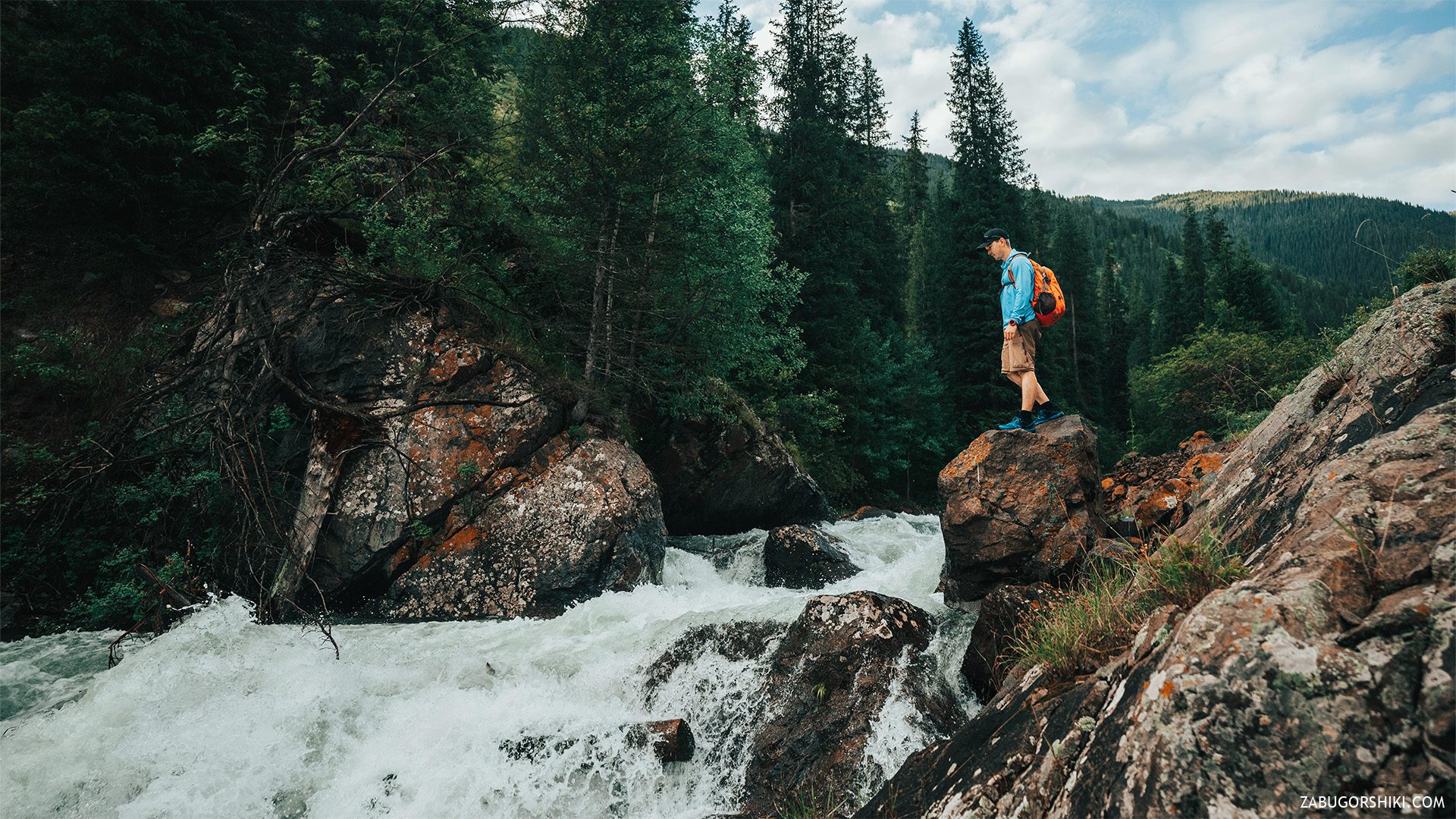
A guided day hike through Turgen Gorge to the 55-metre Kairak Waterfall — the tallest waterfall in the Turgen valley and one of the largest in the Almaty region. 16 km round trip through spruce forest, wild apple groves, and alpine meadows, crossing 11 bridges over the Turgen River.
What to expect on the Kairak Waterfall hike
The Kairak Waterfall hike takes you east of Almaty into Turgen Gorge — a different world from the more visited gorges directly south of the city. Turgen is one of the longest valleys in the Zailiyskiy Alatau at 44 km, and one of the richest in natural features: seven major waterfalls, relict Chin-Turgen moss fir groves with permafrost preserved beneath them from the last ice age, and — most remarkably — the Kuznetsova Gorge genetic reserve protecting Malus sieversii, the wild ancestor of every cultivated apple on Earth.
Your destination is the Kairak Waterfall, 8 km from the village of Batan in the upper reaches of the gorge. The waterfall drops approximately 55 metres in three cascades through a narrow rocky chute, the water milky-white against near-black cliff faces fringed with moss and spruce. The name “kairak” in Kazakh means “grindstone” or “sharpener” — a reference to how the Kairak River has carved its own channel through the rock over millennia, grinding away the stone like a blade against a whetstone.
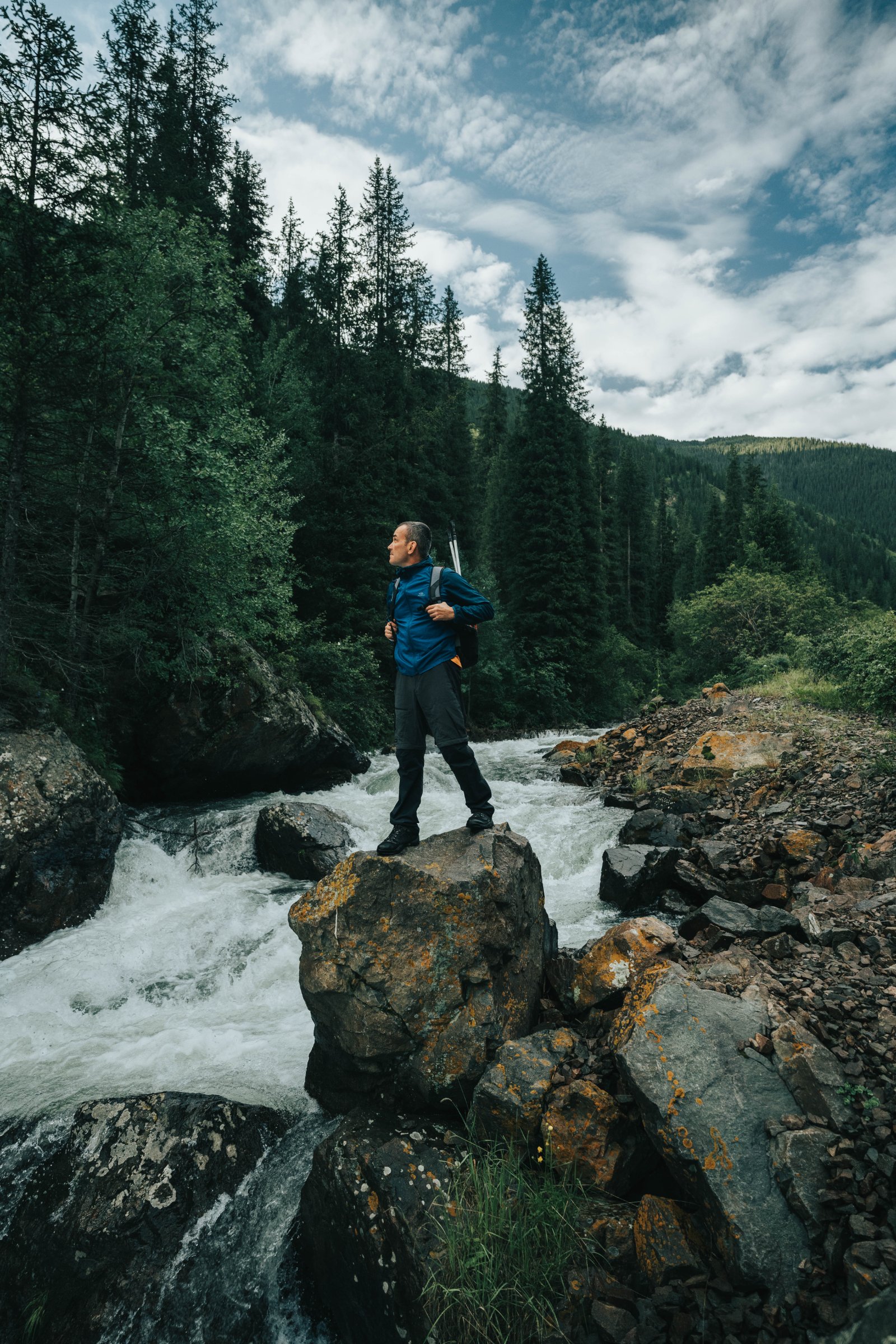
The trail follows the Turgen River upstream on a wide path — originally planned as a national park road, but the main bridge at Batan was washed away by a mudflow in 2004 and never rebuilt, leaving the route permanently pedestrian. You cross 11 wooden bridges over the river as the valley deepens around you. The forest shifts from mixed deciduous woodland (including wild apple and apricot trees in the lower sections) to dense Schrenk’s spruce groves and alpine meadows carpeted with wildflowers in summer. Gazebos and benches are placed along the route at intervals for resting.
The final 1.5 km steepens as you leave the main Turgen valley and follow the Kairak River up its tributary gorge. You hear the waterfall before you see it — and then it appears around the last corner, filling the narrow gorge with spray and noise. A wooden observation bridge near the lower cascade provides the classic viewpoint. Metal stairs allow you to climb higher for a panoramic view of all three cascades.
Detailed itinerary
Almaty to Batan village (1.5–2 hours drive)
We pick you up at your hotel at 7:00–7:30 AM. The drive heads east on the Kuldjinsky highway, passing through Issyk town and turning south toward the mountains. The route enters the Turgen valley through the national park ecological checkpoint.
En route landmarks:
Golden Man statue (8 m): Near the park entrance stands a monument to the Saka (Scythian) warrior whose gold-clad remains were discovered in 1969 in the Issyk kurgan burial mound on the nearby Issyk River bank. The Golden Man dates to the 4th century BC and has become one of Kazakhstan’s most recognisable national symbols. The statue marks the beginning of a region with deep archaeological significance — Silk Road caravans once passed through Turgen Gorge and the Assy Plateau beyond.
Kieli-Bulak spring: Adjacent to the Golden Man statue, this natural spring is believed by locals to have rejuvenating properties. It’s a convenient stop for filling water bottles.
Turgen trout farm: A popular roadside stop where you can watch (or catch) rainbow trout from ponds fed by the Turgen River. If time allows on the return, freshly grilled trout makes an excellent post-hike meal.
We continue driving up the gorge to Batan — the forestry settlement where the asphalt road ends and the hiking begins.
Batan to the Kairak–Turgen confluence (6.5 km, 2–2.5 hours)
The trail begins at the confluence of the Turgen and Kishi-Turgen (Little Turgen) rivers near Batan. The path is wide and well-defined — you’re walking on what was intended to be a vehicle road, so the gradient is gentle and the surface stable. This is the easiest and most enjoyable section of the day.
The 11 bridges: The trail crosses the Turgen River repeatedly via old wooden bridges. Some are solid, others atmospheric. The bridges are a distinctive feature of this hike — each one frames the river differently, from calm pools reflecting the spruce canopy to rushing white water over boulders.
The forest evolves as you climb: The lower sections feature mixed deciduous woodland with wild apple trees (Malus sieversii), apricot, ash, and hawthorn. As you gain altitude, Schrenk’s spruce (the Tien Shan endemic conifer) becomes dominant, forming dense, mossy groves. The understory is rich with wildflowers in June and July — buttercups, geraniums, monkshood, and carpets of endemic grasses.
Wildlife: Turgen Gorge is home to brown bears (rarely seen but present, especially in early spring), Siberian roe deer, wild boar, lynx, and numerous bird species. You’re unlikely to encounter anything more dramatic than a marmot, but the gorge feels genuinely wild — no permanent habitation beyond Batan, no cell service, no vehicle noise.
We stop for tea and snacks at one of the gazebos along the route.
Kairak River tributary to the waterfall (1.5 km, 30–45 minutes)
At the confluence of the Turgen and Kairak rivers, you turn left (south) and follow the smaller Kairak River upstream. The trail narrows and steepens — this is the most physically demanding section. You climb through dense spruce forest with the sound of falling water growing louder.
The waterfall appears suddenly around a final bend. The Kairak Waterfall drops approximately 55 metres in three distinct cascades. The rock face is dark — nearly black — and the water appears milky-white by contrast. Moss and vegetation cling to the cliff edges. Spray reaches the viewing bridge on warm days, creating a cool mist zone at the base.
At the waterfall (30–45 minutes)
Time for photos, lunch, and absorbing the scale of the place. The wooden observation bridge at the base of the lower cascade is the standard viewpoint. For the more adventurous, metal stairs lead up the side of the gorge to a higher vantage point where you can see the full cascade sequence.
The surrounding rock walls create a natural amphitheatre — the sound is constant and enveloping. On sunny days, rainbows form in the spray.
Picnic lunch is served here: sandwiches, dried fruit, tea from a thermos. There’s clean drinking water from springs near the waterfall.
Return to Batan (8 km, 2–2.5 hours)
The return follows the same trail — all downhill, significantly faster. The light is different in the afternoon, revealing aspects of the gorge you missed on the way up. We aim to reach Batan by 3:00–4:00 PM.
Drive back to Almaty (1.5–2 hours)
Optional stop at the trout farm for a fresh grilled fish meal (not included in tour price). Return to your hotel by 5:00–6:00 PM.
Why book a guided Kairak Waterfall hike?
The drive is 80 km each way through unfamiliar territory. Unlike gorges directly south of Almaty, Turgen requires driving east along the highway, turning through Issyk, and navigating a deteriorating road up the gorge. Without a vehicle and a driver who knows the road conditions (which change with weather and season), reaching Batan is logistically challenging. Public transport doesn’t reach the trailhead.
The return is from the same point you started. Unlike a traverse hike, you need your vehicle waiting at Batan — not at a different exit point. With a guided tour, the vehicle and driver are there when you return.
Natural history context transforms the experience. Without a guide, the 11 bridges are just bridges and the forest is just forest. With a guide, you learn that the wild apple trees you’re walking past are Malus sieversii — the genetic ancestor of every Honeycrisp, Fuji, and Granny Smith ever grown — and that this gorge contains one of the last protected reserves of the species that gave Almaty its name (“father of apples”). You learn that the moss fir groves preserve permafrost from the ice age. These stories make the hike.
The world’s apples started here
Every apple you’ve ever eaten — every Gala, every Pink Lady, every Golden Delicious — traces its ancestry to Malus sieversii, a wild apple tree native to the Tien Shan mountains of southeastern Kazakhstan. The first scientific description came from German botanist Johann Sievers, who encountered the trees during an expedition through Central Asia in the 1790s. But it was Soviet biologist Nikolai Vavilov who, in the 1930s, first proposed that these wild forests near Almaty were the origin point of all cultivated apples.
Modern genome sequencing has confirmed Vavilov’s theory. A 2010 study identified Malus sieversii as the primary ancestor of domestic apples, domesticated in this region approximately 3,000–4,000 years ago. Seeds were spread westward along the Silk Road by traders, birds, bears, and horses, hybridising with other species along the way to produce the thousands of varieties we know today.
The Turgen branch of the Ile-Alatau National Park protects some of the best-preserved Malus sieversii populations remaining. The Kuznetsova Gorge genetic reserve, located in the eastern part of Turgen Gorge, contains approximately 200 hectares of wild apple forest with trees up to 160 years old, some yielding up to 900 kg of fruit per tree. Twenty biologically valuable forms have been identified here, five developed into registered clone varieties.
Tragically, wild apple forests in the Almaty region have declined by approximately 80–95% over the past two centuries due to Soviet-era timber felling, urbanisation, and agricultural expansion. The trees you pass on the lower sections of the Kairak trail are among the survivors. Almaty — “father of apples” — is named for them.
When to hike to Kairak Waterfall
Late May – June: Snowmelt feeds the waterfall at peak flow — the most spectacular time. Lower meadows filled with wildflowers. May carries some tick risk (treat clothing and check after the hike). River crossings may be higher in late May.
July – August: Warmest and driest conditions. The waterfall flow decreases but remains impressive (it never dries completely). Wild apples begin fruiting in the lower sections by late August — September. The gorge can feel hot in July; morning starts are best.
September – October: Autumn colours in the deciduous lower forest, especially the apple and apricot trees. Cooler hiking conditions, shorter days. The waterfall flow is at its seasonal lowest but still present.
November – April: The trail is not recommended for casual hiking due to snow and ice. The waterfall partially freezes, forming ice stalactites — reportedly beautiful, but the trail may be dangerous. Winter visits require appropriate gear and experience.
Tick and snake warning: Ticks are present May–June. Snakes have been reported on the trail in recent summers. Wear long pants, use tick repellent, and check your body after the hike.
Frequently asked questions
How does this compare to Butakovka Waterfall? Very different experience. Butakovka is a short, popular hike 15 km from Almaty city centre to a 30 m waterfall — easy, crowded on weekends, and accessible by public transport. Kairak is a full-day expedition 80 km east of Almaty to a much larger (55 m) and more remote waterfall. You see far fewer people, walk through wilder forest, and cross 11 bridges along the way. The trade-off is the 3.5–4 hours of driving.
How hard is the hike? Rated 2/5. The main 6.5 km along the Turgen River is flat and easy — wide path, gentle gradient. Only the final 1.5 km up the Kairak tributary is moderately steep. Anyone with average fitness can complete this hike. Children age 10+ can manage it.
How tall is the waterfall actually? Sources vary between 40 m and 55 m, with some citing 70 m total including all cascade sections and rapids. The main visible cascade is approximately 40–55 m. Regardless of the exact measurement, it’s the tallest waterfall accessible by day hike in the Turgen valley and one of the largest in the Almaty region.
What does “kairak” mean? Most sources translate it as “grindstone” or “sharpener” in Kazakh — describing how the river has carved through the rock. Some sources associate the name with bears, which inhabit the upper gorge. Both interpretations appear in credible local sources.
Can I combine this with Issyk Lake? Yes. Issyk Lake is on the route — you pass through Issyk town driving to Turgen. A combined Issyk Lake + Kairak Waterfall day is ambitious but possible if you leave early. Alternatively, visit Issyk Lake one day and Kairak Waterfall the next.
Is the Bear Waterfall worth adding? The Medvezhiy (Bear) Waterfall is a 30 m waterfall located close to the road in the lower part of Turgen Gorge — only about 30 minutes’ walk from the Ak-Bulak café. It can be visited on the drive back from Kairak with minimal extra time. Recommended if energy and daylight permit.
Are there bears? Brown bears live in Turgen Gorge and are occasionally encountered in early spring when they emerge from hibernation. Sightings on the Kairak trail are rare. Your guide knows how to minimise risk and what to do in an encounter.
Itinerary
Detailed itinerary will be provided upon booking.
Pricing
100% private tour — prices are per person based on group size. The more friends you bring, the less everyone pays!
What's Included
Included
Not Included
Our Guarantee
If weather forces a cancellation, you choose a free reschedule or a full refund. If you're not satisfied with your experience, we'll work with you to make it right. No questions, no hassle.
Private tours only (max 6) · Reschedule or full refund if weather cancels · No payment until confirmed
Traveler Stories
Sarah K.
Our guide was incredible - he adjusted the pace perfectly for our group and knew exactly where to stop for the best photos. The whole experience felt effortless, like everything was taken care of before we even thought to ask.
Marco T.
We were a group of 4 friends and the per-person price made it a no-brainer. Private 4x4, lunch included, and the canyon was breathtaking. Way better than the big bus tours we saw there.
Anna W.
Solo traveler here. I was nervous about hiking alone in a foreign country but the guide made me feel completely safe. The trail to Kok-Zhailau was beautiful and the photos he took of me were amazing. Only wish the hike was longer!
Kuishuai
We really appreciate Eldar as a tour guide, who is very experienced and led us to many unique destinations that few tourists know. Also appreciate Eldar for teaching us how to fly a drone and taking photos of us, and ensuring that we are always safe
Share Your Experience




12+ hikers
completed this trail
Tour At A Glance
Book This Tour
Private tours run any day of the week — weekends fill up fastest, so book early
Pay securely after confirmation




Weather Forecast
broken clouds
H: 6°C
L: -2°C
Fri, Oct 23
broken clouds
-4°C
-8° / 0°
Sat, Oct 24
light snow
-6°C
-9° / -4°
Sun, Oct 25
clear sky
1°C
-3° / 4°
Tour Location
Similar trails
From $70
per person · weather refund
Complete Your Booking
Tour:
Date:
Participants
Add-ons
You're Almost There!
We'll contact you within 24 hours to confirm your spot and share everything you need to prepare for your adventure.
Request sent
We confirm your spot
within 24 hours
Summoning perfect weather
Hit the trail
On the channel



83 h
Drone flight hours

What we’ve filmed
59
Hikes filmed

704 km
Kilometers covered

44,439 m
Elevation gained

27
Countries visited

Plan your hike with us
A few quick questions and we will email you a tailored hike plan & quote.
When do you want to hike?
What's your experience?
How many of you?
Where do we send your plan?
Private guided hikes · no obligation.