
Day Hiking Tour to the Black Waterfall (Tuyuksu) from Almaty
From $83 per person
Overview
Is this tour right for you?
Perfect if you…
No experience needed
Description
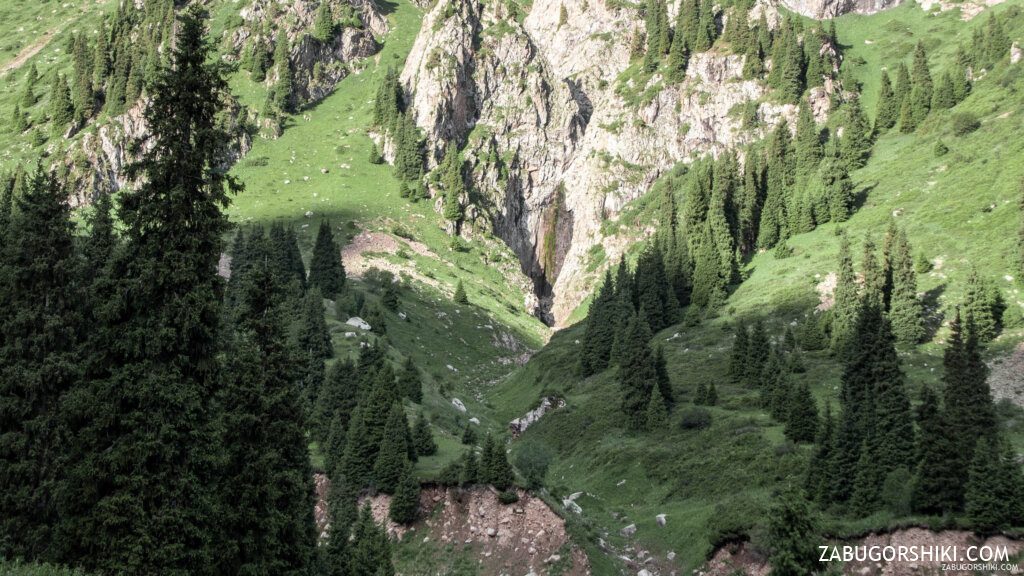
A guided half-day hike from Shymbulak ski resort through the Tuyuksu mountaineering camp to the Black Waterfall — a 30-metre cascade plunging through a deep rock niche of dark stone at 2,650 m in the Small Almaty Gorge.
What to expect on the Black Waterfall hike
The Black Waterfall hike from Almaty takes you into the heart of the Small Almaty Gorge’s mountaineering district — a landscape of granite walls, alpine meadows, and climbing history — to a waterfall that most Almaty tourists have never heard of. While the Butakovka and Gorelnik waterfalls draw steady crowds, the Black Waterfall (Чёрный водопад) sits higher, deeper in the gorge, and in far more dramatic terrain. It’s less famous, but more rewarding.
The waterfall gets its name from the dark, near-black rock through which the water carves its path. At roughly 30 metres, it drops in a single cascade through a deep rock niche that creates the effect of a natural well — steep cliff walls on three sides, the waterfall in front, and open sky above. The setting is genuinely dramatic: the waterfall is surrounded by vertical cliffs favoured by rock climbers, and in early summer, remnants of winter avalanche snow persist in the deep ravine, sometimes forming snow bridges and ice formations at the waterfall’s base well into June and July.
The route from Shymbulak follows the same initial road as the Mynzhylki plateau hike, but after about 1.5 km branches off across the Malaya Almatinka River to the opposite bank. From there, the trail passes through the Tuyuksu mountaineering camp — one of the most historically significant climbing camps in Central Asia — before climbing to the waterfall in a ravine below Peak Medik. The maximum altitude is approximately 2,650 m, making this a genuine high-altitude hike without the extreme commitment of reaching the Mynzhylki plateau (3,000 m) or the peaks beyond.
What makes this hike special is the combination: real mountaineering atmosphere (you walk through an active climbing camp), a waterfall that’s impressive in both scale and setting, altitude that feels genuinely alpine, and the drama of watching the landscape transition from spruce forest and green meadows to bare rock as you climb — the Tien Shan spruce treeline ends at roughly 2,800–2,900 m, and the Black Waterfall sits near the edge of this transition.
The waterfall’s power varies dramatically with the season. In late May and early June, when snowmelt is at its peak, the waterfall runs at full force and is at its most spectacular. By August, the flow diminishes. In winter, the waterfall freezes into a vertical ice cascade — beautiful in a different way, and a draw for ice climbing enthusiasts.
Detailed itinerary
Getting to Shymbulak (1–1.5 hours from hotel)
We pick you up from your Almaty hotel at 8:00–9:00 AM. Drive to Medeo (1,691 m), then cable car or eco-bus to Shymbulak ski resort (2,270 m). The cable car ride itself is scenic — sweeping views of the gorge, the dam, and the spruce-covered slopes.
Shymbulak to river crossing (30–40 minutes)
From Shymbulak, we follow the main dirt road south up the gorge — the same road used for the Mynzhylki hike. After approximately 1.5 km, instead of continuing straight toward the Tuyuksu Gate, we cross the Malaya Almatinka River and continue on the opposite (western) bank.
This initial section is gentle and scenic — the road is flat to mildly rising, with views of the gorge walls and the river below. Your guide points out the vegetation transition as we climb: dense spruce forest and green meadows in the lower section, thinning as altitude increases.
Tuyuksu mountaineering camp (20–30 minutes stop)
The trail passes through the Tuyuksu mountaineering camp — a location with a remarkably long history. Founded in 1939 as “Lokomotiv Vostoka” (Locomotive of the East), this was one of the premier mountaineering training camps of the Soviet era. The Small Almaty Gorge was the birthplace of Kazakhstan’s climbing tradition, and this camp was its centre.
After the Soviet Union collapsed, the camp fell into disrepair. It was revived in 2005 by Baglan Zhunusov, President of the Federation of Mountaineering and Rock Climbing of Kazakhstan. Today, it operates year-round, hosting climbers from across the world who come to attempt the surrounding peaks.
We pause here for context. Your guide shares the camp’s history and points out the peaks visible from this vantage point — many of them first ascended by climbers who trained at this very camp. The Memorial to Mountain Victims, located at the nearby Tuyuksu Gate, honours those who didn’t return.
Ascent to the Black Waterfall (40–60 minutes from camp)
From the camp, the trail climbs into the ravine below Peak Medik. The terrain changes noticeably: the last spruce trees are behind you, and the landscape becomes rocky, spare, and increasingly vertical. The cliffs flanking the ravine are popular with rock climbers — you may see them working routes on the faces above.
The waterfall is not visible until the final approach. The ravine narrows, the rock walls close in, and then the Black Waterfall appears — a 30-metre column of water dropping through a deep vertical niche of dark stone. The “well” effect created by the surrounding cliff walls amplifies the sound and the spray. In early summer, snow and ice remnants at the base add to the drama.
We spend time here for photos, rest, and the experience of standing in this natural amphitheatre. The rock colour — genuinely dark grey to black, distinct from the lighter granite elsewhere in the gorge — is what gives the waterfall its name.
Descent (1–1.5 hours)
The return follows the same trail back to Shymbulak, with the option to descend along a slightly different path through flowering alpine meadows (when the season allows). Cable car or eco-bus back to Medeo, then drive to Almaty. Return to hotel by early-to-mid afternoon.
Why book a guided Black Waterfall hike?
Route finding: The trail to the Black Waterfall branches off the main gorge road and crosses the river — the turnoff is not signed or obvious. Without a guide or GPS track, most hikers continue straight toward Mynzhylki and miss the waterfall entirely.
Mountaineering context: Walking through the Tuyuksu camp and understanding its 85+ year history transforms the hike from a waterfall visit into a journey through Kazakhstan’s climbing heritage. The stories — the Soviet-era pioneers, the camp’s collapse and revival, the peaks named after heroes and victims — add a dimension that no sign can provide.
Safety at the waterfall: The ravine below Peak Medik involves rocky terrain, potential snow/ice remnants, and slippery surfaces near the waterfall. The “well” effect means the waterfall area can be cold and wet even in summer. A guide ensures safe approach and knows when conditions at the waterfall are dangerous (early spring avalanche risk, ice instability).
When to visit the Black Waterfall
Late May – early June: The best time. Snowmelt feeds the waterfall at maximum flow, and the combination of remaining avalanche snow at the base with the rushing water is visually spectacular. The waterfall is at its most powerful and photogenic during this window.
July–August: Standard summer season. The waterfall flows but at reduced volume compared to spring. Alpine wildflowers on the approach trail. Warm and comfortable hiking conditions. Most accessible period.
September: Low water flow but beautiful autumn light. The surrounding cliffs show well against clear skies. Fewer hikers.
Winter (November–March): The waterfall freezes into a vertical ice cascade. Beautiful for photography and ice climbing. Requires winter equipment (crampons, warm layers). Avalanche risk in the ravine — only with experienced winter guide.
Frequently asked questions
How high is the Black Waterfall? Approximately 30 metres — a single cascade dropping through a vertical rock niche. Not the tallest waterfall near Almaty (the Kairak waterfall in Turgen Gorge is 55 m), but the setting — dark rock walls creating a “well” effect, surrounded by climbing cliffs — makes it one of the most dramatic.
Why is it called the “Black” Waterfall? The rock through which the water flows is a notably dark grey-to-black stone, distinct from the lighter granite found elsewhere in the Small Almaty Gorge. The dark rock contrasts sharply with the white water, creating a striking visual.
How does this compare to other waterfalls near Almaty? The Black Waterfall is more remote and higher in altitude than most Almaty waterfalls. Butakovka (30 m, ~1,900 m elevation) is easier to reach and more popular. The Gorelnik waterfalls (5 m and 20 m) are closer to Medeo. The Bear Waterfall (Ayusay, 5–10 m cascades) is the easiest to access. The Black Waterfall offers the most alpine, least-crowded waterfall experience of any of them.
Can I combine this with the Mynzhylki hike? The routes overlap for the first 1.5 km from Shymbulak. Theoretically you could visit the Black Waterfall and then continue to Mynzhylki, but that creates a very long day (8+ hours of hiking). A better approach: do the Black Waterfall as a half-day, or pair it with the Tuyuksu camp visit. Mynzhylki deserves its own full day.
When is the waterfall at its most powerful? Late May through early June — the peak snowmelt period. The waterfall is dramatically more powerful during this window than in mid-to-late summer. If timing your visit specifically for the waterfall, target this period.
Is this suitable for children? The trail itself is manageable for fit children over 10–12. The main challenges are altitude (2,650 m can cause mild symptoms), the river crossing, and rocky terrain near the waterfall. Not recommended for young children.
What is Peak Medik? A peak in the Small Almaty Gorge above the Tuyuksu camp. The Black Waterfall is located in a ravine on the flanks of this peak. The surrounding cliffs are popular with rock climbers.
Do I need special equipment? No technical equipment needed for the summer hike. Good hiking boots (not sneakers), warm layers, and waterproof outer layer are sufficient. In winter, crampons and proper winter gear are essential.
The tour price includes your Medeo-Shymbulak gondola ticket (2026 tariff).
Itinerary
Detailed itinerary will be provided upon booking.
Pricing
100% private tour — prices are per person based on group size. The more friends you bring, the less everyone pays!
What's Included
Included
Not Included
Our Guarantee
If weather forces a cancellation, you choose a free reschedule or a full refund. If you're not satisfied with your experience, we'll work with you to make it right. No questions, no hassle.
Private tours only (max 6) · Reschedule or full refund if weather cancels · No payment until confirmed
Traveler Stories
Sarah K.
Our guide was incredible - he adjusted the pace perfectly for our group and knew exactly where to stop for the best photos. The whole experience felt effortless, like everything was taken care of before we even thought to ask.
Marco T.
We were a group of 4 friends and the per-person price made it a no-brainer. Private 4x4, lunch included, and the canyon was breathtaking. Way better than the big bus tours we saw there.
Anna W.
Solo traveler here. I was nervous about hiking alone in a foreign country but the guide made me feel completely safe. The trail to Kok-Zhailau was beautiful and the photos he took of me were amazing. Only wish the hike was longer!
Kuishuai
We really appreciate Eldar as a tour guide, who is very experienced and led us to many unique destinations that few tourists know. Also appreciate Eldar for teaching us how to fly a drone and taking photos of us, and ensuring that we are always safe
Share Your Experience
Tour At A Glance
Book This Tour
Private tours run any day of the week — weekends fill up fastest, so book early
Pay securely after confirmation




Weather Forecast
light rain
H: -1°C
L: -6°C
Fri, Oct 23
light snow
-10°C
-15° / -6°
Sat, Oct 24
clear sky
-13°C
-17° / -10°
Sun, Oct 25
clear sky
-7°C
-11° / -3°
Tour Location
Similar trails
From $83
per person · weather refund
Complete Your Booking
Tour:
Date:
Participants
Add-ons
You're Almost There!
We'll contact you within 24 hours to confirm your spot and share everything you need to prepare for your adventure.
Request sent
We confirm your spot
within 24 hours
Summoning perfect weather
Hit the trail
On the channel



83 h
Drone flight hours
What we’ve filmed
59
Hikes filmed
704 km
Kilometers covered

44,439 m
Elevation gained

27
Countries visited

Plan your hike with us
A few quick questions and we will email you a tailored hike plan & quote.
When do you want to hike?
What's your experience?
How many of you?
Where do we send your plan?
Private guided hikes · no obligation.