
Kok-Tobe: Almaty’s Highest Viewpoint and Gateway to the Mountains
From $56 per person
Overview
Is this tour right for you?
Perfect if you…
No experience needed
Description
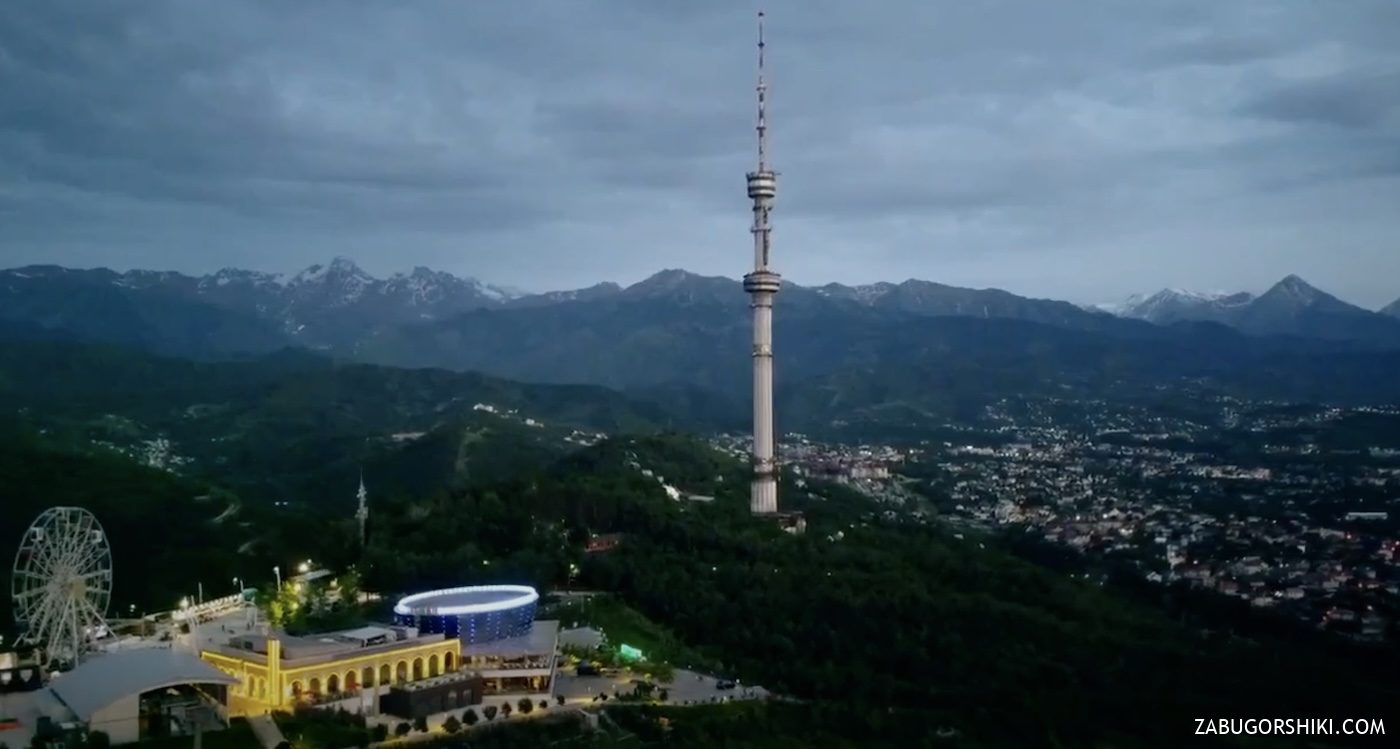
Kok-Tobe (Köktöbe) is a hill on the southeastern edge of Almaty, rising to approximately 1,100 m above sea level — roughly 200 m above the city centre. It’s the highest point within Almaty’s city limits and the location of the 371.5-metre Almaty TV Tower, the tallest free-standing tubular steel structure in the world. A cable car connects the city centre to the hilltop park in six minutes.
Why Kok-Tobe matters for mountain visitors
This is the first place every visitor to Almaty should go. Not because of the amusement rides or the Beatles statue or the apple-shaped fountain — though those exist — but because Kok-Tobe gives you the single best orientation to Almaty’s relationship with its mountains.
Stand on the northern viewing platform and look south. The entire Zailiyskiy Alatau ridge fills your field of vision: from Kumbel Peak (3,200 m) in the west to Talgar Peak (5,017 m) in the east, with everything in between — Big Almaty Peak (3,682 m), Furmanov (3,053 m), the Shymbulak valley, and the pyramid of Almaty Peak (4,376 m) — laid out like a topographic map made real.
This is where you decide which mountain to climb. Point at a peak, and we’ll take you there.
Practical information
| Opening hours | Daily from 10:00 (13:00 on Tuesdays) until 23:00; to midnight Friday-Sunday and holidays. Hours shift for events – check on the day |
| Cable car | 10,000 ₸ return / 6,000 ₸ one-way for adults; children 6-12 return 5,000 ₸ (2026 tariff) – prices change often, verify at the ticket office |
| The ride | 1,620 m, about 6 minutes, +250 m over the old “Kompot” quarter |
| Hill height | ~1,100 m above sea level – the best city-and-mountains panorama without leaving Almaty |
| Time needed | 2-3 hours; best light from late afternoon through sunset |
| On foot | 30-40 minutes up from the base if you skip the cable car |
How to get to Kok-Tobe
Cable car (recommended): The lower station is on Dostyk Avenue, next to the Palace of the Republic — a glass building near Hotel Kazakhstan. The upper station is inside Kok-Tobe Park. The ride covers 1,620 m in approximately six minutes, gaining about 250 m in elevation. It passes directly over the residential neighbourhood known locally as “Kompot” (named after the street Compote Lane — the old pre-Soviet quarter with traditional houses and gardens).
Current ticket prices (verify before visiting — prices change frequently): Cable car return: approximately KZT 8,000 for adults (roughly $16 USD as of mid-2025). One-way tickets are also available. Children’s tickets cheaper. These prices will have changed — check the official Kok-Tobe website or ticket office on the day.
Getting to the cable car station: Abay metro station is approximately 900 m walk. Buses on Dostyk Avenue (lines 5, 5A, 12, 29 and others) stop nearby. A Yandex taxi from central Almaty costs under KZT 1,500 (~$3).
By road: Bus 99 runs to the Kok-Tobe stop from the city. By taxi or private car, a winding road leads up to the hilltop parking area. From the parking lot, you walk approximately 1 km uphill to the park — a detail that catches some visitors off guard.
On foot: A walking trail ascends from the base of the hill. The walk is moderately steep and takes 30–40 minutes. In spring, the hillside is covered with wildflowers. This is the most rewarding approach if you have the energy — you earn the view.
Operating hours: The park is typically open daily 10:00 AM – 11:00 PM, but hours and seasonal closures vary. The cable car occasionally closes for maintenance (sometimes for weeks). Always confirm before planning your visit.
What to see and do at Kok-Tobe
The viewing platforms
Kok-Tobe has several viewing platforms facing different directions. The city view to the north is the headline: Almaty’s grid of streets, Soviet-era apartment blocks, modern glass towers, and green parks spread across the plain. On clear days (early morning or after rain), the view extends over 100 km north into the steppe.
The mountain view to the south is equally important, though one honest note: mature trees along the southern slopes partially obstruct the view of the highest peaks from some platforms. The best unobstructed mountain panorama is from the restaurant area near the Ferris wheel. Evening is spectacular — the mountains glow in sunset light while the city begins to sparkle below.
The Almaty TV Tower
The tower dominates Kok-Tobe’s silhouette. It was built between 1975 and 1983 — an eight-year construction project that produced one of the most distinctive structures in Central Asia. Some key facts:
The tower stands 371.5 m tall. It’s built entirely from tubular steel rather than reinforced concrete — making it unique among the world’s major TV towers. It’s the tallest free-standing tubular steel structure on Earth, a record it has held since completion. Its top reaches 1,452 m above sea level.
The tower was engineered for one of the most seismically active cities in the world. Almaty sits on a major fault zone and has been destroyed by earthquakes multiple times in its history (most recently in 1887 and 1911). The tower was designed to withstand a magnitude 10 earthquake — an engineering achievement that reflected both Soviet ambition and genuine geological necessity.
The structure contains observation decks at 146 m and 252 m, accessible by high-speed elevators, plus three underground floors that can serve as a bomb shelter. The tower is currently closed to the public — plans for renovation and reopening as a tourist attraction have been discussed for years but not yet realised. If and when the observation decks open, they’ll offer the most extraordinary viewpoint in all of Kazakhstan.
The architects were Terziev, Savchenko, Akimov, and Ostroumov. The tower was formally commissioned on June 1, 1984.
The Beatles monument
Unveiled in 2007, this was the first monument to The Beatles in the entire former Soviet Union. John Lennon sits on a bench holding a guitar; Paul McCartney, George Harrison, and Ringo Starr stand around him. The statue sits next to the “I Love Almaty” sign — the most photographed spot in the park.
The Beatles’ connection to Almaty might seem tenuous, but their music was enormously influential in Soviet Kazakhstan. Bootleg recordings of Beatles songs circulated widely in the 1970s and 1980s, and for many young Kazakhstanis, the band represented a window to a different world. The monument was installed on the initiative of local fans.
Other attractions
Alma Fountain: An apple-shaped fountain at the park entrance. “Alma” means apple in Kazakh — the city of Almaty is literally “City of Apples,” named for the wild apple forests (Malus sieversii) that once covered the surrounding foothills. Visitors throw coins and make wishes.
Ferris wheel: A 30-metre wheel offering elevated views — particularly good for photography, as it lifts you above the treeline for an unobstructed mountain panorama.
Fast Coaster: An alpine coaster (downhill rail sled) that runs down the mountainside. Originally 770 m, it has been extended to 1,100 m. The ride provides an adrenaline hit with mountain views — popular with families.
Zoo and exotarium: A small collection of local and exotic animals. Modest but entertaining for children.
Restaurants and cafes: Several options ranging from casual snack stands to sit-down restaurants with terrace views. Prices are higher than city restaurants but the views compensate.
Health trail: A walking path that descends from the main park to a lower observation platform, offering a quieter alternative to the main tourist areas.
A brief history of Kok-Tobe
From Verigina Mountain to Green Hill
Before it became Kok-Tobe, this hill was called Verigina Mountain — after a wealthy merchant named Verigin who built his estate at its base. The name appeared on maps and in tourist brochures from the 19th century, when the city was still called Verny (the tsarist-era Russian fortress town).
Even then, the hill served as a recreational escape. Residents of Verny picnicked here, gathered wildflowers in spring, and went sledging in winter. The hilltop offered the same thing it offers today: a view of mountains that made daily life feel small.
The mountain’s history goes deeper. The lands around Kok-Tobe were once part of the Wusun confederation — the powerful semi-nomadic state that controlled the Ili River valley from the 2nd century BC to the 5th century AD. Later, the hilltop reportedly served as a gathering point for the military council of Zholbarys Khan, where strategies for defending the surrounding territory were debated.
Soviet transformation
In the 1960s, Almaty’s Communist Party leadership — under First Secretary Dinmukhamed Kunaev — initiated the transformation of the hill into a public park. The centrepiece was the cable car: designed and built with Georgian engineers from Tbilisi, it opened on November 4, 1967, becoming the first cable car system in Central Asia. The park opened the same day.
The hill was renamed Kok-Tobe (variously transliterated as Kok-Tyube, Koktobe, or Köktöbe). The name translates from Kazakh as “Green Hill” — though “kök” in Kazakh carries the same blue-green ambiguity as in many Turkic languages, and some sources translate it as “Blue Hill.”
The TV tower construction began in 1975, adding the structure that would define Almaty’s skyline for the next half-century. The tower was completed in 1983 and commissioned in 1984.
Modern era
The cable car was seriously reconstructed in 2005 and again in 2015–2016, when new poles were built, new upper and lower stations constructed, and 17 modern gondolas replaced the two original Soviet-era cabins. In 2006, Kok-Tobe Park was expanded into a full entertainment complex with attractions, restaurants, and event spaces.
Today, the park hosts concerts, film screenings, opera performances, running events, and cultural festivals throughout the year.
Kok-Tobe as your first day in Almaty
If you’re visiting Almaty for hiking, Kok-Tobe is the ideal arrival-day activity. Here’s why:
Orientation. From the viewing platforms, you can physically see the mountains you’ll be hiking in the coming days. Your guide can point out exact peaks and gorge entrances, giving you a spatial understanding that no map provides.
Acclimatisation. Almaty city centre sits at approximately 800–900 m above sea level. Kok-Tobe is at 1,100 m. If you’ve flown in from near sea level, spending your first afternoon at a gentle 1,100 m — rather than jumping straight to a 2,500+ m trailhead — is a sensible altitude adjustment.
Jet lag management. The cable car, the walking, the fresh mountain air, and the sunset views provide enough sensory engagement to keep you awake through the crucial first evening, helping reset your body clock before a proper hike the next day.
Anticipation. Looking at the mountains from Kok-Tobe creates the desire to enter them. This is where the adventure begins emotionally, even if physically you’re still in the city. Clients who visit Kok-Tobe on Day 1 arrive at the trailhead on Day 2 already motivated.
We can include a Kok-Tobe visit as part of your first-day orientation before any multi-day hiking programme.
The mountains you can see from Kok-Tobe (and how to hike them)
From Kok-Tobe’s southern viewing platforms, looking left (east) to right (west), here are the major peaks visible on clear days — and links to our guided hiking tours:
Talgar Peak (5,017 m) — the highest point of the Zailiyskiy Alatau, far to the southeast. A distant white pyramid visible on exceptionally clear days. Expedition-grade mountaineering.
Almaty Peak / Komsomol Peak (4,376 m) — the sharp pyramid directly south. The highest point on the city skyline. 2-day guided climb, category 2A-2B.
Chkalov (3,892 m) and Fizkulturnik (4,068 m) — the peaks flanking the Bogdanovich Glacier approach. Visible as the ridge to the left of Almaty Peak.
Furmanov Peak (3,053 m) — the prominent peak above Medeo and Kim Asar Gorge. Day hike, difficulty 3/5.
The Shymbulak valley — the ski resort visible as a cleared swath on the mountain face. Starting point for Mynzhylki Plateau, Bogdanovich Glacier, and the T-1 Station hikes.
Big Almaty Peak (3,682 m) — the broad pyramid to the south-southwest. Day hike, difficulty 4/5. The trail to Big Almaty Lake passes below it.
Kumbel Peak (3,200 m) — visible to the southwest as part of the western ridge. Day hike, difficulty 4/5.
On very clear days, the mountain panorama extends from the Turgen gorge area in the east (where Kairak Waterfall is located) to the Kaskelen gorge in the west.
Frequently asked questions
Is Kok-Tobe worth visiting? Yes, particularly on a clear day. The city and mountain panorama is the best you’ll get without leaving Almaty. Budget 2–3 hours. The cable car ride alone — passing over the rooftops of old Almaty — is worth the ticket. Best time: late afternoon through sunset.
What does “Kok-Tobe” mean? “Köktöbe” translates from Kazakh as “Green Hill” — though “kök” in Kazakh and other Turkic languages occupies the blue-green spectrum, so “Blue Hill” also appears in some translations. Both are technically correct.
Can I walk to the top? Yes. A trail and road ascend from the base. Allow 30–40 minutes walking uphill. The walk is pleasant in spring (wildflowers) and autumn (clear air). In summer midday heat, the cable car is more comfortable.
Is the TV tower open to visitors? No. The tower has observation decks at 146 m and 252 m with elevators, but they have never been regularly open to the public. Renovation plans for tourist access have been announced multiple times but not completed. Check locally for updates — this could change.
When is the best time to visit? Late afternoon for the best mountain light and sunset views. Weekdays are significantly less crowded than weekends. After rain, the air clears and visibility extends dramatically — if it rained yesterday, go today. Winter evenings offer city lights but mountains may be obscured by haze. Spring mornings are exceptional for mountain photography.
Is Kok-Tobe good for kids? Yes. The Ferris wheel, Fast Coaster, zoo, and various rides make it a family-friendly half-day outing. The cable car itself entertains most children.
What are Kok-Tobe’s opening hours?
The cable car runs daily from 10:00 (from 13:00 on Tuesdays) until 23:00, and until midnight on Fridays, weekends and holidays – so an evening visit is almost always possible, and sunset from the top is the best reason to go. Hours occasionally shift for events, so check on the day for a late ride.
How much does the Kok-Tobe cable car cost?
On the 2026 tariff an adult return ticket is 10,000 ₸ (~$20), one-way 6,000 ₸, and a children’s return (ages 6-12) 5,000 ₸. Prices rise most years – treat these as a guide and confirm at the ticket office on the day. A taxi to the lower station from anywhere central costs under 1,500 ₸.
You might also like
- Medeo in Almaty — the famous ice-skating rink and gateway to the mountains, visible from Kok-Tobe
- Shymbulak — the ski resort visible on the mountainside from Kok-Tobe. Starting point for glacier and peak hikes
- Kok-Zhailau Hike — the plateau between the Big and Small Almaty gorges. Your first real mountain hike from the city, difficulty 2/5
- Big Almaty Lake Day Tour — the turquoise alpine lake at 2,511 m, nestled below the peaks visible from Kok-Tobe
- Butakovka Waterfalls — accessible forest waterfall hike in the gorge east of Kok-Tobe
- Eagle’s Nest Viewpoint — another city panorama, this time from the mountain trails above Medeo
- Ak-Kayin Birch Grove — the easiest guided walk in the mountains, difficulty 1/5. Perfect for the day after Kok-Tobe
Itinerary
Detailed itinerary will be provided upon booking.
Pricing
100% private tour — prices are per person based on group size. The more friends you bring, the less everyone pays!
What's Included
Included
Not Included
Our Guarantee
If weather forces a cancellation, you choose a free reschedule or a full refund. If you're not satisfied with your experience, we'll work with you to make it right. No questions, no hassle.
Private tours only (max 6) · Reschedule or full refund if weather cancels · No payment until confirmed
Traveler Stories
Sarah K.
Our guide was incredible - he adjusted the pace perfectly for our group and knew exactly where to stop for the best photos. The whole experience felt effortless, like everything was taken care of before we even thought to ask.
Marco T.
We were a group of 4 friends and the per-person price made it a no-brainer. Private 4x4, lunch included, and the canyon was breathtaking. Way better than the big bus tours we saw there.
Anna W.
Solo traveler here. I was nervous about hiking alone in a foreign country but the guide made me feel completely safe. The trail to Kok-Zhailau was beautiful and the photos he took of me were amazing. Only wish the hike was longer!
Share Your Experience
Tour At A Glance
Book This Tour
Private tours run any day of the week — weekends fill up fastest, so book early
Pay securely after confirmation




From $56
per person · weather refund
Complete Your Booking
Tour:
Date:
Participants
Add-ons
You're Almost There!
We'll contact you within 24 hours to confirm your spot and share everything you need to prepare for your adventure.
Request sent
We confirm your spot
within 24 hours
Summoning perfect weather
Hit the trail
On the channel



83 h
Drone flight hours
What we’ve filmed
59
Hikes filmed
704 km
Kilometers covered

44,439 m
Elevation gained
27
Countries visited

Plan your hike with us
A few quick questions and we will email you a tailored hike plan & quote.
When do you want to hike?
What's your experience?
How many of you?
Where do we send your plan?
Private guided hikes · no obligation.