Freeride Skiing & Snowboarding in Kazakhstan
Overview
Description
Kazakhstan is emerging as one of Central Asia’s most compelling freeride destinations — and almost nobody in the international skiing world knows it yet. The country sits at the intersection of two major mountain systems (the Tien Shan and the Altai), both of which deliver the ingredients that matter: steep terrain, reliable snowfall, and virtually no crowds.
The basics: Kazakhstan offers three distinct freeride zones, each with its own character, snow quality, and access model. The Almaty area delivers ski-touring and lift-accessed off-piste close to a major city. The Kazakh Altai in the east provides deep powder, snowcat/snowmobile-accessed terrain, and heli-skiing. And the Turgen gorge offers wild, isolated backcountry for experienced ski-tourers who want genuine remoteness.
Zone 1: Shymbulak, Ak-Bulak & the Almaty backcountry
Location: 20–40 km south of Almaty, Zailiyskiy Alatau range, Tien Shan.
Shymbulak is Kazakhstan’s best-known ski resort — and the launch point for the Almaty freeride scene. Beyond the groomed runs, the mountains above and around Shymbulak offer extensive off-piste terrain: open bowls above the lift system, forested couloirs on the flanks of the Kumbel ridge, and — for those willing to skin — routes deep into the Tuyuk-Su cirque beneath four-thousanders.
Snow conditions. Almaty’s mountains receive less snow than the eastern Altai. Major snowfall events cluster in late February, March, and April. Between storms, the snowpack can be thin and wind-affected. This makes the Almaty zone primarily a ski-touring (skitour/splitboard) destination rather than a lift-accessed powder zone — you earn your turns.
Key areas:
Shymbulak lift-accessed off-piste. After heavy snowfall, the terrain above the top station and off the ridges beside the groomed runs provides a few hours of tracked-out powder before the crowds arrive. Best early morning, gone by noon.
Tuyuk-Su backcountry. The real prize. From Shymbulak or the Mynzhylki plateau, skin into the Tuyuk-Su glacier area beneath Peak Molodezhnaya (4,147 m) and the Kumbel ridge. Routes run from the Cosmostation (3,340 m) down through glacier terrain — 1,000+ m descents on north-facing slopes that hold snow well into spring. This is serious alpine terrain requiring avalanche awareness, glacier skills, and a guide who knows the crevasse fields.
Ak-Bulak resort. 40 km east of Almaty near Talgar. After heavy snow, the forested slopes off the second lift and the black run provide excellent tree skiing. The resort occasionally closes the upper section for safety — which is precisely when the off-piste is best.
Cosmostation ski touring. A unique Almaty experience: skin up to the Soviet cosmic-ray research station at 3,340 m, sleep in the scientists’ hut, and ski down the next morning. Routes from the Cosmostation access the slopes of Peak Turan (3,970 m) and the upper Big Almaty Gorge — terrain that receives almost no ski traffic.
Season: Late February – May. Best powder: March–April. Spring corn snow on glaciers: May.
Zone 2: The Kazakh Altai — East Kazakhstan
Location: Near Ridder (formerly Leninogorsk), ~2 hours from Ust-Kamenogorsk, East Kazakhstan.
This is the zone that makes international freeriders pay attention. The Kazakh Altai receives enormous snowfall — snowpack can reach 5 metres by mid-winter — and the snow quality is exceptional: light, dry, and deep. The terrain is more rolling and forested than the steep Tien Shan, with wide open bowls, birch-tree glades, and long descents through old-growth taiga. The altitude is lower (1,500–3,000 m) but the snow volume compensates.
Access models:
Snowcat (ratrak). The most common format. A tracked vehicle carries you to ridgetops for multiple runs per day. Average cost: ~$100/day.
Snowmobile. Faster access to more remote terrain. Average cost: ~$200/day.
Heli-skiing. The ultimate East Kazakhstan experience. Helicopter access to untracked alpine terrain above the treeline, with 1,000+ m descents through virgin powder. Starting from ~$1,000,000 KZT per person (~$2,000 USD).
Freeride bases near Ridder: Vostochny Polyus (Eastern Pole), Ulba Camp, Altay Mountain Lodge, Ridder Resort Hotel. All offer accommodation, guiding, and snowcat/snowmobile access.
Getting there: Fly Almaty → Ust-Kamenogorsk (1.5 hours), then drive 2 hours to Ridder.
Season: Mid-December – March. Best conditions: February. December–January can see extreme cold (-30°C), but the powder is untouched.
Who it’s for: All levels of off-piste skiers and snowboarders. The terrain includes gentle tree runs for intermediate freeriders and steep open faces for experts. This is the zone to recommend for international visitors who want the “Kazakhstan powder” experience.
Zone 3: Turgen Gorge — wild backcountry
Location: Turgen gorge, ~70 km east of Almaty, Zailiyskiy Alatau.
The most remote and least developed of the three zones. A local outfit operates a yurt camp in the gorge and offers guided ski touring (skitour) into terrain that sees almost no human traffic in winter. The Karash mountains above Turgen provide steep alpine terrain with long descents into forested valleys.
This is strictly a backcountry/ski-touring zone — no lifts, no snowcats, no groomed access. You skin up, you ski down, you sleep in a yurt. The snow quality varies (Turgen sits between the dry Almaty zone and the wetter eastern ranges), but after storms the terrain delivers.
Who it’s for: Experienced ski-tourers with their own equipment who want genuine wilderness. Not suitable for beginners or those expecting resort-style amenities.
Season: January – March.
Types of freeride in Kazakhstan
Lift-accessed off-piste — Shymbulak and Ak-Bulak after heavy snowfall. Available only during and immediately after storms.
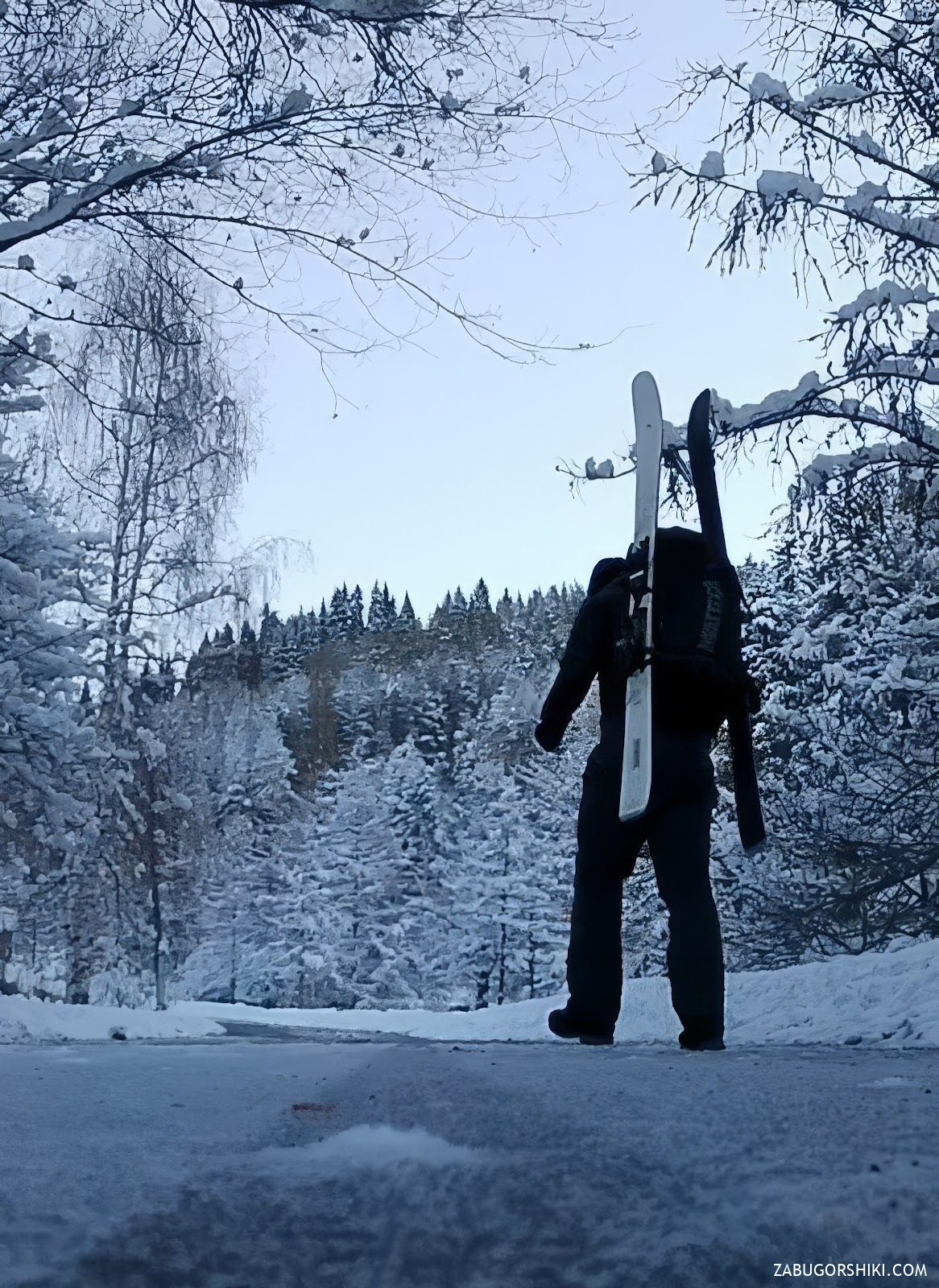
Ski touring / backcountry (skitour / splitboard) — self-powered ascents with skiing/riding down. The primary format near Almaty and in Turgen. Requires fitness, avalanche training, and touring equipment.
Snowcat / snowmobile-accessed — the main East Kazakhstan format. Multiple runs per day with mechanical uplift to ridge-tops. No skinning required.
Heli-skiing — premium experience in the Kazakh Altai. Helicopter access to virgin terrain above treeline.
Avalanche safety
Freeride in Kazakhstan is not a resort experience. Avalanche conditions vary significantly between zones and throughout the season. Critical points:
The Almaty mountains have a complex snowpack due to irregular snowfall and strong winds. Weak layers can persist for weeks. Spring warming triggers wet slides on south-facing slopes.
The Kazakh Altai’s heavy snowfall creates a more homogeneous snowpack, but the sheer depth means natural avalanches during and after storms are common.
All freeride in Kazakhstan should be done with a qualified mountain guide who carries avalanche rescue equipment (transceiver, probe, shovel) and has current avalanche assessment training. We do not publish exact route descriptions for freeride lines — conditions change daily, and following a written route without current assessment is dangerous.
Itinerary
Detailed itinerary will be provided upon booking. Our typical tour includes daily hikes through diverse terrains and cultural experiences.
Traveler Stories
Sarah K.
Our guide was incredible - he adjusted the pace perfectly for our group and knew exactly where to stop for the best photos. The whole experience felt effortless, like everything was taken care of before we even thought to ask.
Marco T.
We were a group of 4 friends and the per-person price made it a no-brainer. Private 4x4, lunch included, and the canyon was breathtaking. Way better than the big bus tours we saw there.
Anna W.
Solo traveler here. I was nervous about hiking alone in a foreign country but the guide made me feel completely safe. The trail to Kok-Zhailau was beautiful and the photos he took of me were amazing. Only wish the hike was longer!
David R.
Third time booking with these guys. Butakovka, Big Almaty Lake, and now Titov Peak. Every single time the service is flawless. The fact that it's always private and max 6 people makes such a difference compared to other operators.
Share Your Experience
Tour At A Glance
165
Videos on the channel

13,000+

16,000+

59
Hikes Filmed
704,000 m
Total Distance

44,439 m
Total Elevation Gain

812 cups
Grand Cru Tea Cups

27
Countries Visited

83 hours
Drone Flight Hours
10 videos
Sports: Running, Snowboard
3 videos
Healthy Eating

1
Living on the Edge