
Overview
Is this hike right for you?
Perfect if you…
No experience needed
Description
A full-day drive from Almaty to the Ili River steppe — combining the Nomad Fortress film set (built for Kazakhstan’s $40 million epic “Nomad: The Warrior”) with the 17th-century Buddhist petroglyphs at Tamgaly Tas, approximately 110 km north of the city.
What to expect on the Nomad City tour from Almaty
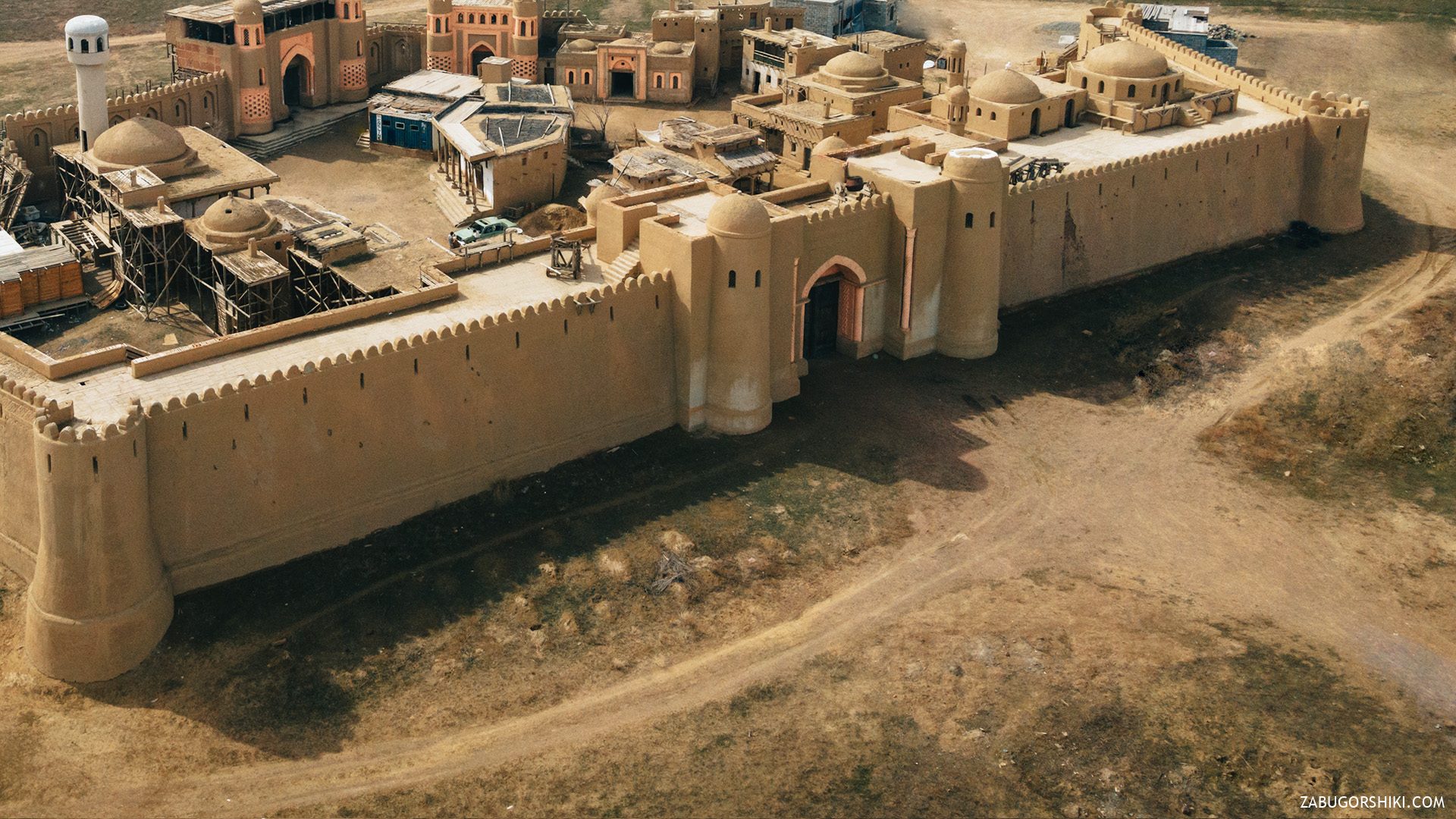
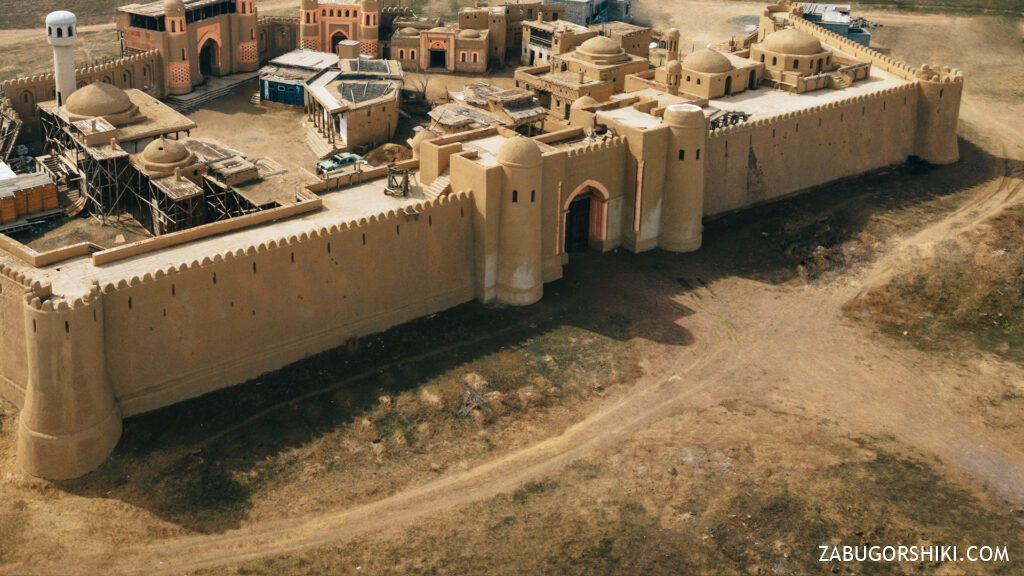
The Nomad City tour from Almaty takes you out of the mountains and into the steppe — a landscape most visitors to Almaty never see. About 110 km north of the city, on the left bank of the Ili River past the Kapchagai Reservoir, sits a walled medieval city that never existed. It was built in 2004 as a film set for “Nomad: The Warrior,” the most expensive Kazakh movie ever made, and it’s still standing — clay-covered foam walls, fortress towers, fake mosque, and all. Across the river, Buddhist deities carved into rock faces in the 17th century by Dzungar artisans stare out over the water. The combination is genuinely strange and genuinely interesting: a modern movie set pretending to be the 18th century, next to actual historical carvings that are older than anything in the set they’re mimicking.
This is not a hiking tour. It’s a steppe road trip — a day spent in flat, open landscape that feels nothing like the alpine world south of Almaty. The Ili River valley, the Kapchagai Reservoir, the empty hills, and the wind are the point. For visitors who’ve already done Big Almaty Lake and the mountain gorges, this is the day trip that shows the other Kazakhstan.
Detailed Itinerary
Drive from Almaty north to Kapchagai (1–1.5 hours)
We pick you up from your accommodation and head north on the Almaty–Taldykorgan highway (A3). The city sprawl eventually gives way to dry steppe as the road descends from Almaty’s elevation (~800 m) toward the Ili River basin. You pass through Konayev (formerly Kapchagai), a small city on the reservoir’s southern shore that was historically known for its casinos and beach resorts — Kazakhstan’s attempt at a local Las Vegas. The reservoir itself, created by damming the Ili River in 1970, stretches wide and flat to the horizon.
Tamgaly Tas — Buddhist petroglyphs on the Ili River (1–1.5 hours)
Past Kapchagai, the road continues north along the Ili River. A turnoff leads to Tamgaly Tas (“Stones with Signs”), an open-air petroglyph site on the river’s right bank where Buddhist imagery was carved directly into cliff faces rising up to 60 meters above the water.
The carvings date primarily to the late 17th century and were commissioned by Galdan Boshugtu Khan, the Dzungar ruler who was also a deeply devout Buddhist with training in Tibetan art. Beginning in 1677, he and his artisans created five large images of Buddhist deities on 15 separate rock blocks: Avalokitesvara Bodhisattva (the four-armed patron deity), Buddha Shakyamuni, and Buddha Bhaisajyaguru (the healing Buddha). Tibetan mantras — including “Om Mani Padme Hum” — and prayer inscriptions surround the figures.
The most recent inscription is a lengthy text in “Clear Script” (Oirat writing) left in 1771 by Volga Kalmyks who had fled to the Ili River valley. It thanks the depicted Buddhas for “overcoming danger and disease” and for “peace and prosperity in the country.”
This is not a typical Central Asian petroglyph site with stick-figure hunters. The Buddhist images are large-scale, finely contoured, and remarkably well-preserved. Finding Tibetan Buddhist iconography carved on steppe cliffs along a Central Asian river is unusual — a reminder that the religious map of this region was very different before the 18th century.
Important: Tamgaly Tas is often confused with the UNESCO-listed Tamgaly Petroglyphs (also called Tanbaly), which are a separate site about 170 km from Almaty featuring Bronze Age carvings. They’re in different locations. Your guide will ensure you reach the correct site.
Access note: The final stretch to Tamgaly Tas is on a dirt road. An SUV is recommended, which is what we use.
Nomad City — the film set on the Ili River (1–1.5 hours)
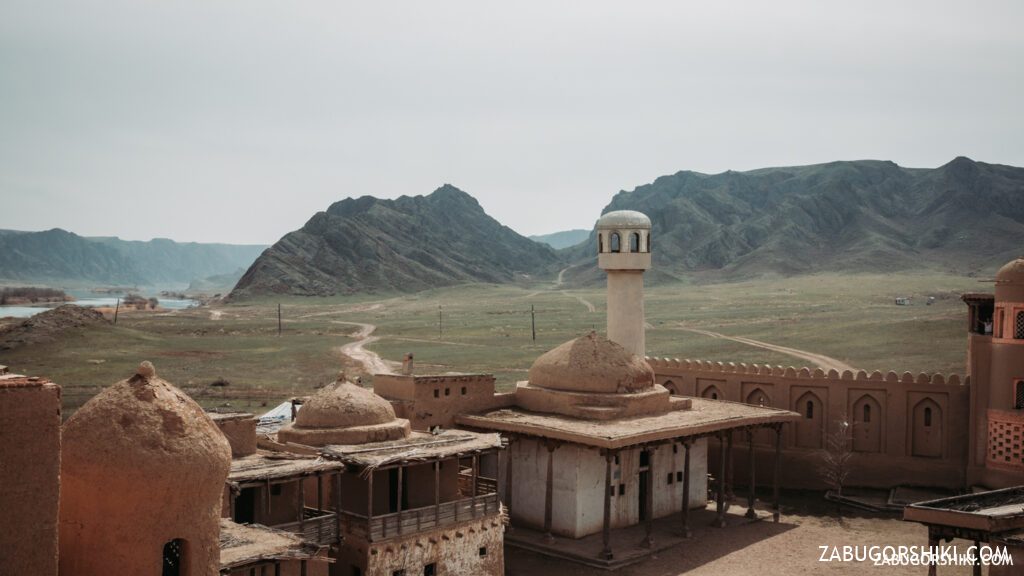
On the opposite (left) bank of the Ili River, a walled city rises from the steppe. This is the set built for “Nomad: The Warrior” (Kazakh: Көшпенділер), released in 2005, and located about 30 km from Konayev.
The film behind the set. In the early 2000s, the Kazakh government invested approximately $34–40 million (sources vary) to produce a historical epic about Ablai Khan — the 18th-century warrior who united Kazakhstan’s three warring tribal unions (zhuz) against the invading Dzungar Khanate. The film was co-directed by Sergei Bodrov and Ivan Passer, executive-produced by Miloš Forman, and featured an international cast including Kuno Becker, Jay Hernandez, Jason Scott Lee, and Mark Dacascos. The production used roughly 13,000 prop weapons, 150 yurts, and 2,000 extras.
The film was presented on July 6, 2005 in Astana with President Nazarbayev in attendance, submitted as Kazakhstan’s entry for the 79th Academy Awards (not nominated), and eventually released in North America by The Weinstein Company in 2007 — where it earned $79,123 at the box office. Critics praised the cinematography and battle scenes but criticized the acting and script. The film’s real legacy, arguably, is this abandoned set.
What you’ll see. The complex includes a massive gateway, fortress walls with towers, a mosque with minarets, a central square, a zindan (underground prison), craft workshops, a khan’s headquarters, and residential buildings — shacks, houses with arched windows, and structures with straw roofs. Everything was built from foam plastic covered in clay to look authentic on camera. Up close, it’s theatrical — ceramic-tile paint has peeled in places to reveal the construction underneath, and cardboard details have weathered — but the overall scale and setting against the steppe and hills is surprisingly atmospheric.
The set has been used for other productions since “Nomad,” including the Russian blockbuster “Day Watch” (2006), the TV series “Kazakh Khanate,” and various music videos. Today it functions as an ethnocultural tourist complex with periodic cultural events, workshops, and photoshoots. Thematic events are held here periodically. There’s an ethnographic camp on the grounds.
What to do here. Walk through the “streets,” photograph the fortress and steppe backdrop, explore the buildings (some are open), and appreciate the absurdity and charm of a movie set that became a real tourist destination. Cultural activities — horseback riding, archery, traditional games — may be available depending on the season and whether events are scheduled. Your guide will know what’s on offer during your visit.
Return to Almaty (1.5–2 hours)
We drive back south through the steppe and Kapchagai to Almaty. Optional stop for a meal along the way.
The film that built a city: “Nomad: The Warrior”
The story behind the Nomad City set is as interesting as the set itself. After independence in 1991, Kazakhstan’s government embarked on nation-building projects to define a post-Soviet Kazakh identity. One initiative was producing a grand historical epic that would showcase Kazakh heritage to a global audience — and counter the satirical portrayal that would come later with Borat (2006).
The screenplay, written by Azerbaijani screenwriter Rustam Ibragimbekov (“Burnt by the Sun”), told a fictionalized version of the youth of Ablai Khan, the 18th-century ruler who united the Kazakh tribes against the Dzungar invasion. The production was an international affair: Czech-American director Ivan Passer started the film, but it shut down mid-production due to financial and weather problems. The Weinstein brothers bought the project and brought in Russian director Sergei Bodrov to finish it. Miloš Forman served as executive producer. Two versions were shot — one in Kazakh for domestic audiences, one in English for international release.
The result was a film with gorgeous steppe cinematography and impressive battle choreography, wrapped around a generic script that Variety diplomatically described as “fearlessly embrac[ing] cliché.” It’s worth watching before your visit — not because it’s a great film, but because standing in the actual set afterward gives it a surreal, layered quality.
Tamgaly Tas: Buddhist heritage on the Kazakh steppe
The Buddhist petroglyphs at Tamgaly Tas are the more historically significant stop on this tour, even if the film set is the more photogenic one.
The carvings reflect a period when the Dzungar Khanate — a confederation of Oirat Mongol tribes — controlled much of what is now southeastern Kazakhstan. The Dzungars were Tibetan Buddhists, and their ruler Galdan Boshugtu Khan (r. 1671–1697) was not just a military leader but a devout Buddhist trained in Tibetan art and iconography. The Tamgaly Tas petroglyphs are his personal commission: a riverside temple carved into living rock, combining sophisticated Tibetan artistic technique with Central Asian scale.
The irony is worth noting: the Dzungars were the very invaders that Ablai Khan — whose story the Nomad film tells — fought to expel from Kazakh lands. The petroglyphs and the film set, sitting on opposite banks of the same river, represent two sides of the same 18th-century conflict. Your guide can walk you through this connection.
The petroglyphs are included in the State list of historical and cultural monuments and have been under state protection since 1981. However, vandalism remains a concern. Treat the site with respect — touch nothing.
Why book this guided tour to Nomad City?
Three reasons. First, getting to both sites independently requires an SUV, knowledge of unmarked dirt roads, and the ability to find Tamgaly Tas without getting lost (it’s routinely confused with the unrelated UNESCO Tamgaly site, which is in a completely different location). Second, neither site has English-language signage or interpretation — without a guide, the petroglyphs are mysterious carvings and the film set is just an abandoned movie location. Third, the historical context connecting the two sites — the Dzungar-Kazakh conflict, the Buddhist heritage, the nation-building film project — is invisible without someone to explain it. This is a tour where the guide is the content.
FAQ: Nomad City and Tamgaly Tas Tour
Is this tour suitable for children? Yes. Both sites involve flat, easy walking. Children generally enjoy the Nomad City set — it’s essentially a life-sized castle to explore. Be aware there is no shade, so sun protection for kids is essential.
How far is Nomad City from Almaty? Approximately 110 km north, about 1.5–2 hours by car depending on traffic through Konayev (Kapchagai). The last section to both Tamgaly Tas and Nomad City involves unpaved roads.
Do I need an SUV? For the final stretch to both sites, yes. The paved road ends before reaching the petroglyphs and the film set. We provide an SUV for all our tours to these sites.
Is Tamgaly Tas the same as the UNESCO Tamgaly Petroglyphs? No. These are two separate sites with similar names. Tamgaly Tas (on the Ili River, ~120 km from Almaty) features 17th-century Buddhist carvings. The UNESCO-listed Tamgaly Petroglyphs (also called Tanbaly, ~170 km from Almaty) feature Bronze Age rock art dating to 3,500–2,500 BCE. They are in different locations. Our tour visits Tamgaly Tas.
Can I combine this with Charyn Canyon? Not in a single day — Charyn Canyon is about 200 km east of Almaty, in the opposite direction from Nomad City. They make excellent back-to-back day trips for visitors with two days to explore the steppe.
Is the Nomad City film set well-maintained? It’s weathering. The structures were built from foam plastic and clay for film purposes, not permanence. Some cardboard details have peeled, and the buildings show their age. This is part of the appeal — it’s an authentic abandoned film set, not a polished theme park. Periodic events and maintenance keep the core structures accessible.
When is the best time to visit? Spring (April–May) and autumn (September–October) are ideal. Summer temperatures in the Ili River steppe regularly exceed 35°C with little shade. Winter is cold and windy but uncrowded.
Is there food available at the sites? No. There are no cafes, restaurants, or shops at either Tamgaly Tas or the Nomad City. Bring all food and water you need. We provide snacks and water on our guided tours.
What is the historical connection between the two sites? The Buddhist petroglyphs at Tamgaly Tas were created by the Dzungar Khanate, Tibetan Buddhist rulers who controlled this region in the 17th–18th centuries. The Nomad City film set tells the story of Ablai Khan, the Kazakh leader who fought to expel those same Dzungars. The petroglyphs and the film set sit on opposite sides of the same river, representing two sides of the same historical conflict.
Should I watch the film before visiting? It enhances the visit but isn’t required. “Nomad: The Warrior” (2005) is available on various streaming platforms. It’s a visually impressive but critically mixed film — think gorgeous steppe cinematography with a predictable script. Standing in the actual set afterward is the real payoff.
Itinerary
Detailed itinerary will be provided upon booking. Our typical tour includes daily hikes through diverse terrains and cultural experiences.
Pricing
| Group Size | 1 person | 2 people | 3 people | 4 people | 5 people | 6 people Best value |
|---|---|---|---|---|---|---|
| Standard | $190 $190 total | $118 $236 total | $94 $282 total | $82 $328 total | $74 $370 total | $70 $420 total |
100% private tour — prices are per person based on group size. The more friends you bring, the less everyone pays!
What's Included
Included
Not Included
Our Guarantee
If weather forces a cancellation, we reschedule at no cost. If you're not satisfied with your experience, we'll work with you to make it right. No questions, no hassle.
Private tours only (max 6) · Free cancellation up to 48 hours before · No upfront payment
Traveler Stories
Sarah K.
Our guide was incredible - he adjusted the pace perfectly for our group and knew exactly where to stop for the best photos. The whole experience felt effortless, like everything was taken care of before we even thought to ask.
Marco T.
We were a group of 4 friends and the per-person price made it a no-brainer. Private 4x4, lunch included, and the canyon was breathtaking. Way better than the big bus tours we saw there.
Anna W.
Solo traveler here. I was nervous about hiking alone in a foreign country but the guide made me feel completely safe. The trail to Kok-Zhailau was beautiful and the photos he took of me were amazing. Only wish the hike was longer!
David R.
Third time booking with these guys. Butakovka, Big Almaty Lake, and now Titov Peak. Every single time the service is flawless. The fact that it's always private and max 6 people makes such a difference compared to other operators.
Share Your Experience
Tour At A Glance
Book This Tour
Weekend slots fill up fast — book early to get your preferred date
Pay securely after confirmation




Similar trails
Day Hiking Tour to the Black Waterfall (Tuyuksu) from Almaty
From $72/person
Day Tour to Lake Kaindy (Sunken Forest) from Almaty
From $95/person
Day Hiking Tour to Karakungei Peak from Almaty
From $56/personFrom $70
per person · free cancellation
Complete Your Booking
Tour:
Date:
Participants:
Price:
You're Almost There!
We'll contact you within 24 hours to confirm your spot and share everything you need to prepare for your adventure.
165
Videos on the channel

13,000+

16,000+

59
Hikes Filmed

704,000 m
Total Distance

44,439 m
Total Elevation Gain

812 cups
Grand Cru Tea Cups

27
Countries Visited

83 hours
Drone Flight Hours

10 videos
Sports: Running, Snowboard

3 videos
Healthy Eating

1
Living on the Edge