
Guided Tour to Altyn-Emel National Park from Almaty – Singing Dune, Aktau Mountains & Ancient Burial Mounds
From $184 per person
Overview
Is this hike right for you?
Perfect if you…
We've got you covered
Description
A 1–3 day guided 4×4 expedition from Almaty to Altyn-Emel National Park — Kazakhstan’s largest national park (520,000 hectares), a UNESCO Biosphere Reserve and World Heritage Site. The park contains landscapes that don’t exist together anywhere else on Earth: a singing sand dune that hums like a pipe organ, chalk mountains painted in white, red, green, and blue from 400 million years of geological layering, frozen lava from Permian-era volcanoes, wild Przewalski’s horses roaming the steppe, and 2,500-year-old Saka royal burial mounds.
Located 250 km northeast of Almaty. No public transport. No mobile coverage inside the park. No cafes, no ATMs, no infrastructure beyond a few ranger posts and a guesthouse in Basshi village. This is Kazakhstan at its rawest — and a guided 4×4 tour is the only practical way for most visitors to experience it.
What to expect on the Altyn-Emel tour
Altyn-Emel National Park is the opposite of everything else in this catalogue. Where our mountain hikes take you into forests, glaciers, and alpine meadows above Almaty, Altyn-Emel takes you into desert steppe, volcanic rock, and geological time measured in hundreds of millions of years. The name means “Golden Saddle” in Kazakh — after the shape of one of its mountain ridges.

The park sits in the Ili River valley between the Dzungarian Alatau mountains to the north and the Kapchagai Reservoir to the south. It was established on April 10, 1996, to protect both its unique geology and its wildlife — including species that exist almost nowhere else in the wild. In 2023, Altyn-Emel was inscribed on the UNESCO World Heritage List as part of the transnational “Cold Winter Deserts of Turan” site. It also holds UNESCO Biosphere Reserve status.
The park is enormous: 200 km from west to east, 30 km from north to south. It has three official tourist routes, two separate entrance points that don’t connect internally, and unpaved roads that require a 4×4 or high-clearance vehicle. The terrain shakes apart ordinary cars. A guided tour with a competent driver, a proper vehicle, and a guide who understands the park’s logistics isn’t a luxury — it’s the difference between seeing everything and getting stranded with a flat tyre in a mobile dead zone.
The four main attractions
1. The Singing Dune (Aigaykum)
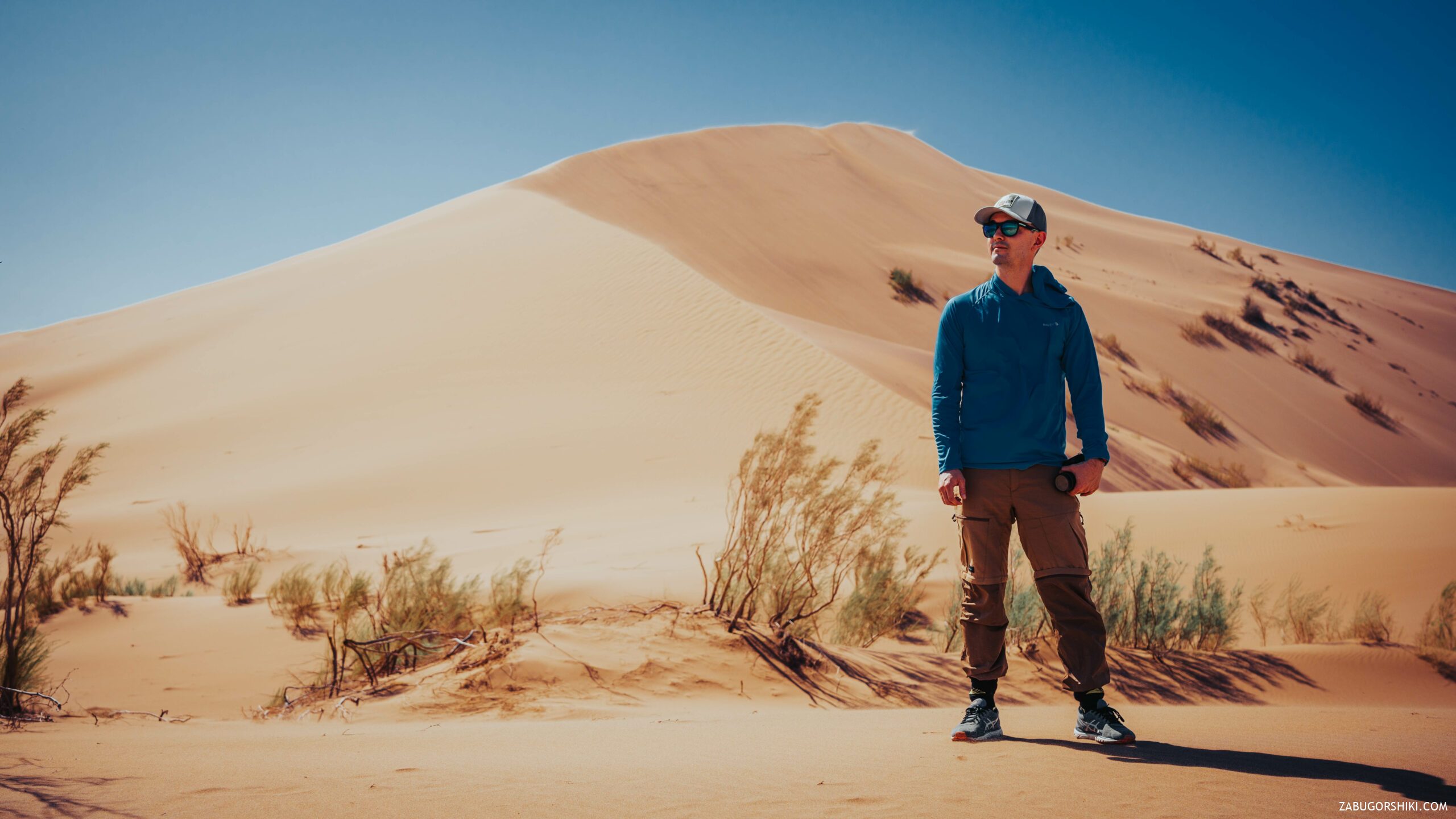
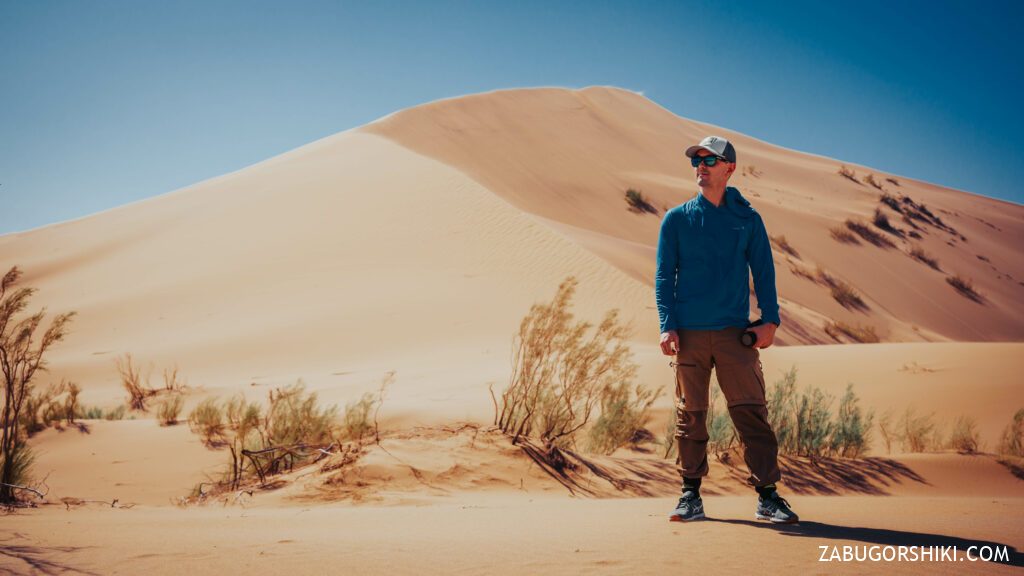
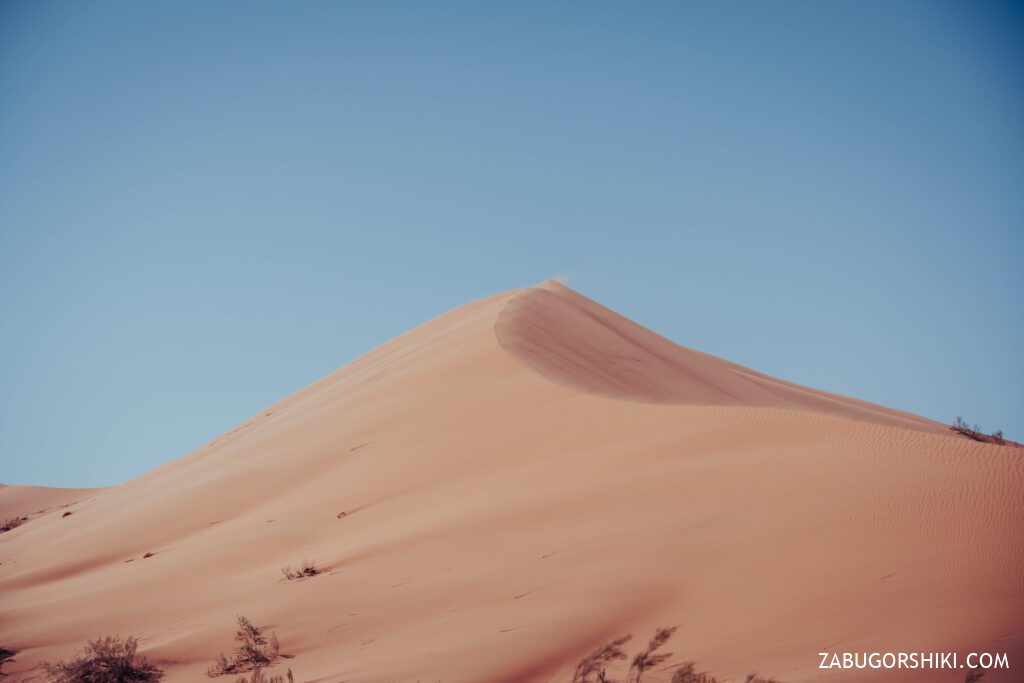
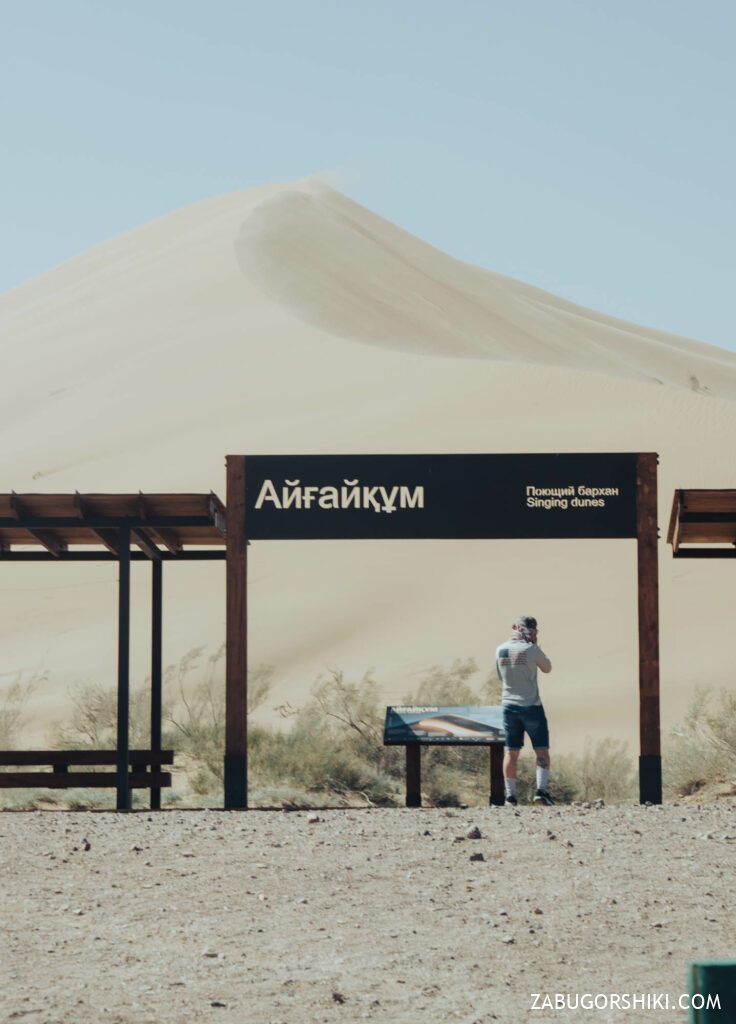
The park’s most famous feature: a crescent-shaped sand dune 1.5 km long and approximately 120–150 m high, standing alone in a valley between the Greater and Lesser Kalkan mountain ranges. There is no other sand anywhere nearby — the dune exists because prevailing winds have spent thousands of years lifting sand particles from the Ili River shallows and depositing them in this natural wind tunnel between the mountains.

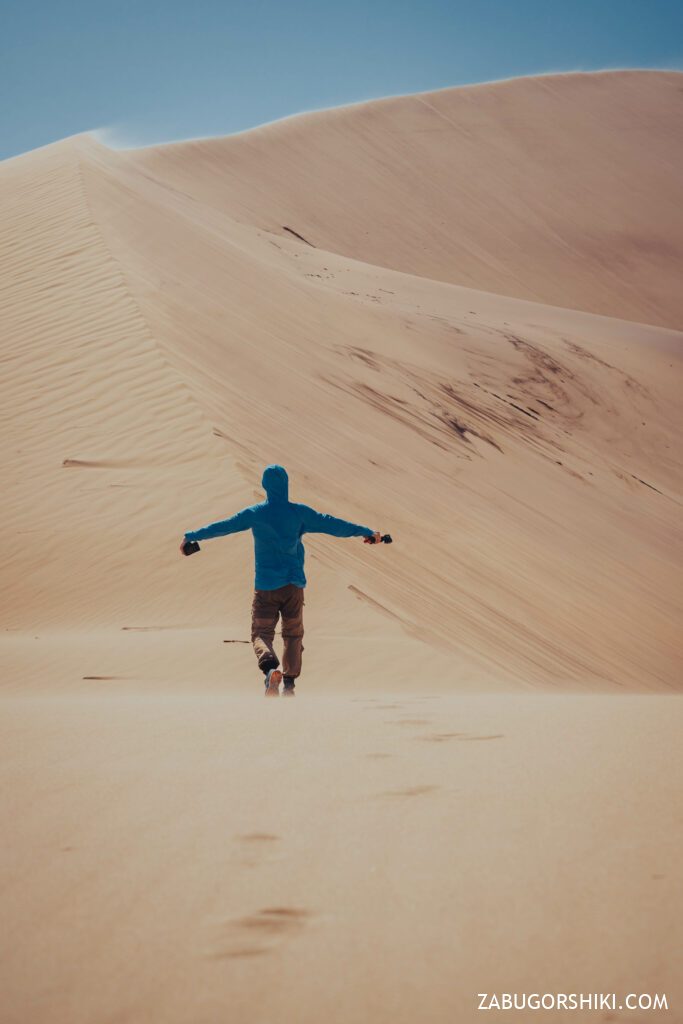
In dry, windy conditions, the dune produces sound. A gentle breeze creates a faint squeak. Stronger winds generate a deep, sustained hum — described variously as a pipe organ, a distant aircraft engine, or a low singing note. Even walking on the dune or sliding down it can trigger the sound as sand grains vibrate against each other. The exact physics remain debated, but the leading theory involves electrostatic charge building between sand grains during friction in dry conditions.
Fewer than 30 sand dunes worldwide produce this phenomenon. The Singing Dune of Altyn-Emel is one of the most accessible.
You can climb to the top — barefoot is traditional, and the soft sand provides a natural foot massage. The summit view takes in the Ili River, the Kalkan ranges, the distant Dzungarian Alatau to the north, and the Zailiyskiy Alatau (including the peaks above Almaty) to the south.
Note: Camping near the Singing Dune is prohibited. The nearest camping site is the Mynbulak ranger post, 10 km away. Toilet facilities and gazebos are available near the dune.
2. The Aktau Mountains
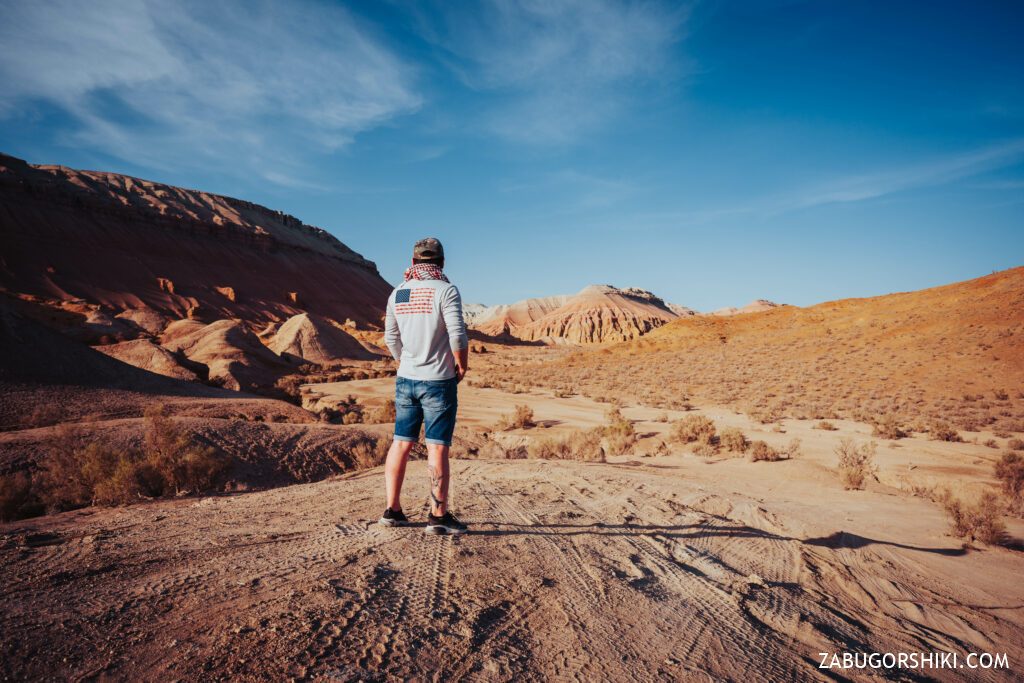
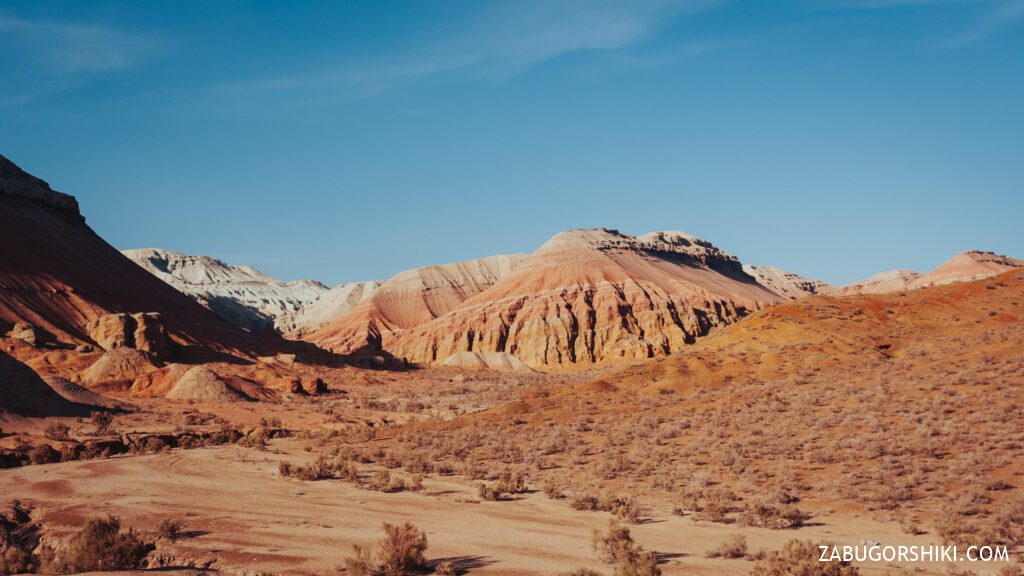
“Aktau” means “White Mountains” in Kazakh, but that undersells them dramatically. These are layered sedimentary formations created at the bottom of an ancient body of water — possibly the Tethys Ocean — during the Mesozoic era. Over 400 million years, different geological periods deposited different-coloured layers: white chalk, grey sandstone, red clay, green marl, blue-grey shale, pale yellow limestone. Erosion has carved these layers into ravines, canyons, and ridges that look like they belong on another planet.
The comparison that every visitor reaches for is “Mars” or “the Moon.” Both are accurate for different sections: the red clay formations look Martian; the white chalk canyons look lunar.
The Aktau Mountains are also a significant palaeontological site. Fossils of prehistoric animals dating back 25–30 million years have been found here — remnants of the creatures that lived around the shores of the ancient lake whose bed became these mountains.
You can park at a designated area and walk through the formations for 2–3 hours. No marked trails — you navigate by terrain. Bring water; there are no water sources in the Aktau area.
3. The Katutau Mountains
“Katutau” translates from Turkic as “Severe Mountains” — and the name fits. These are the remains of Permian-era volcanoes, active approximately 250 million years ago, near the end of the geological period that culminated in the largest mass extinction in Earth’s history.
What you see today is solidified lava eroded by 250 million years of sun, frost, rain, and wind into surreal sculptural forms — arches, towers, collapsed craters, and twisted rock formations in deep reds and blacks. The highest point of the Katutau reaches 1,720 m. The landscape is violent and beautiful in equal measure.

The Katutau are located en route to the Aktau mountains from Basshi and can be visited together in a single day. The road to Katutau is the worst in the park — rarely graded by a bulldozer, deeply corrugated, and punishing on vehicles and passengers.
4. The Besshatyr Burial Mounds
“Besshatyr” means “Five Tents” in Kazakh — the mounds resemble pavilions from a distance. This is a Saka-era royal necropolis: 31 burial mounds dating to the 6th–4th centuries BC, built by the Saka Tigrahauda (the Eastern Scythians who inhabited modern Kazakhstan during the Iron Age).
The mounds stretch 2 km north-south and 1 km east-west. They’re graded by social status: the largest (50–100 m diameter) were for tribal leaders and rulers; medium ones (30–40 m) for famous warriors and clan heads; smaller ones (15–25 m) for ordinary warriors. Archaeologists have excavated 31 mounds, finding gold-plated horse trappings, gold ornaments and utensils, weapons, and armour — everything the ancient nomads believed a warrior would need in the afterlife.
The largest mound — dubbed “The Tsarist One” — was the most richly decorated. These are the same Saka people who created the Golden Man (Altyn Adam), the 4th-century BC warrior whose golden armour was found in a kurgan near Issyk, east of Almaty. The Golden Man is now Kazakhstan’s national symbol.
Important logistical note: Besshatyr is accessible only from the western entrance near Shengeldy village — NOT from Basshi. You cannot drive through the park from Basshi to Besshatyr. Visiting both the Singing Dune/Aktau (Routes 1 & 2, from Basshi) and Besshatyr (Route 3, from Shengeldy) requires exiting and re-entering the park. This is why a 3-day tour is recommended for comprehensive coverage.
Tour format and itinerary options
Option A: 2-Day Tour (Singing Dune + Aktau/Katutau)
The most popular format. Covers Routes 1 and 2 from the northern entrance at Basshi.
Day 1: Almaty → Basshi → Singing Dune
Depart Almaty at 7:00–8:00 AM. The drive covers approximately 250 km (4–5 hours) via the toll highway through Konaev (formerly Kapchagai), crossing the Ili River, then through the Arkharly and Altyn-Emel mountain passes to Basshi village. Arrive around noon. Obtain park permits at the Basshi office (cash only, KZT). After lunch, drive to the Singing Dune (approximately 50–60 minutes from Basshi).
En route to the dune, the steppe road passes through wildlife territory with views of the Dzungarian Alatau. Common sightings include Persian gazelles, kulans (Turkmen wild asses), foxes, and hares. At the Shygan ranger post, you can request permission to see the Przewalski’s horse enclosure.
Other stops en route: Oshaktas stone menhirs (purpose unknown, likely related to nearby Saka burial mounds), Chokan Valikhanov’s Spring (named after the father of Kazakh ethnography), and turanga poplar groves (endangered endemic species).
Arrive at the Singing Dune in late afternoon — the best time for warm light and photographs. Climb the dune (30–45 minutes), experience the panorama from the summit. Return to Basshi for dinner and overnight at guesthouse.

Day 2: Aktau + Katutau Mountains → Return to Almaty
Early departure. Drive to the Aktau and Katutau mountains (approximately 90 minutes from Basshi). Visit the Kosbastau oasis en route — a grove of ancient trees sustained by warm radon springs, including the famous 700-year-old willow discovered during geological fieldwork in 1960.
Explore the Katutau volcanic formations (1–1.5 hours walking), then continue to the Aktau chalk mountains (2–3 hours walking through the geological layers). No marked trails — your guide navigates by terrain knowledge.
Depart the park mid-afternoon. Return to Almaty by evening (4–5 hours drive). Hotel drop-off by 8:00–9:00 PM.

Option B: 3-Day Tour (Complete Park — All Three Routes)
Adds the Besshatyr burial mounds and Tanbaly Tas petroglyphs, accessible only from the western entrance. This is the comprehensive option for visitors who want the full geological, zoological, and archaeological experience.
Day 1: As Option A Day 1 (Singing Dune) Day 2: Aktau + Katutau mountains. Overnight Basshi Day 3: Exit park, drive to western entrance near Shengeldy. Visit Besshatyr burial mounds and Tanbaly Tas petroglyphs (Bronze Age rock carvings depicting animals, riders on horseback and camelback). Views over Kapchagai Reservoir. Return to Almaty via the western highway.
Option C: Combined Tour — Altyn-Emel + Charyn Canyon
Altyn-Emel pairs naturally with Charyn Canyon (approximately 220 km from Basshi). A 3-day combined itinerary visits Charyn Canyon on Day 1 (or en route), then continues to Altyn-Emel for Days 2–3. This is the most efficient way to see both landmarks in a single trip from Almaty.
Why book a guided Altyn-Emel tour?
No public transport exists. There are no buses, marshrutkas, or shared taxis to Basshi or anywhere inside the park. Without your own 4×4 vehicle, a guided tour is the only option.
The roads destroy ordinary cars. Park roads are unpaved and deeply corrugated — the surface is graded by bulldozer, creating washboard ridges every few centimetres. The section to Katutau is the worst. Rental companies often refuse to let standard vehicles enter the park. A flat tyre in a mobile dead zone, 50 km from the nearest village, is a genuine risk.
The park has no mobile coverage. Inside the park, there is no phone signal and no internet. Basshi village has 4G; inside the park, you’re off-grid. Your guide carries communication equipment and knows the ranger post locations.
Navigation is non-trivial. There are no trail markers in the Aktau or Katutau formations. GPS tracks exist online but require offline maps (2GIS app recommended). A guide who knows which canyon to enter, where the fossils are, and how to read the terrain saves hours of wandering.
Wildlife spotting requires local knowledge. Przewalski’s horses, kulans, and gazelles are present but elusive. Your guide knows where herds typically gather, what time of day sightings are most likely, and can negotiate access to the Przewalski horse enclosure at the Shygan ranger post.
The logistics are complex. Two entrances (Basshi and Shengeldy), three non-connecting routes, a park that closes at sunset, a permit system that requires cash payment at an office with a lunch break — a guide who has done this dozens of times handles the bureaucracy while you focus on the landscape.
The wildlife of Altyn-Emel
Altyn-Emel may look empty. It is not. The park supports 78 mammal species, 260+ bird species, 25 reptile species, and 1,800+ plant species. Eleven mammals are listed in Kazakhstan’s Red Book of endangered species.
Przewalski’s horse (Equus ferus przewalskii): The last truly wild horse species on Earth. Altyn-Emel maintains a breeding population as part of a global reintroduction programme. These are not feral horses — they are a genetically distinct species that was never domesticated. Extinct in the wild by the 1960s, the species has been gradually reintroduced to its native Central Asian habitat from captive populations. Seeing them in their natural steppe environment is one of the most significant wildlife experiences in Kazakhstan. The Shygan ranger post maintains an enclosure where horses can be observed at close range — ask your guide to arrange access.
Kulan (Equus hemionus kulan): The Turkmen wild ass. Altyn-Emel’s kulan population has exceeded 2,600 animals — a conservation success story. They’re commonly spotted from the road as herds of stocky, sandy-coloured equines galloping across the steppe.
Persian gazelle (Gazella subgutturosa): Also called the goitered gazelle. Common throughout the park, often spotted in small groups near the road to the Singing Dune.
Other notable species: argali (mountain sheep), Tien Shan brown bear, lynx, manul (Pallas’s cat), stone marten, polecat, otter, and Bukhara deer. Black stork and imperial eagle among 260+ bird species. You’re unlikely to see the big cats or bears without extreme luck, but gazelles, kulans, and birds are regular sightings.
Flora: Ancient white and black saxaul forests, ironwood groves, Sievers apple trees (Malus sieversii — the ancestor of all cultivated apples, the same species found in the Turgen valley), and endangered turanga poplars.
Practical information
Best time to visit: May–June and September–October. Summer (July–August) is extremely hot — temperatures exceed 40°C on the steppe and walking in the Aktau formations becomes dangerous. April and late October are cooler but can bring rain that turns unpaved roads to mud. Winter visits are possible but the park’s appeal is diminished by cold and limited daylight.
What to bring:
- Sunscreen and hat (essential — there is zero shade in most of the park)
- Minimum 3 litres water per person per day inside the park
- Closed-toe shoes for walking in the Aktau/Katutau formations (sharp rocks)
- Warm layer for evenings (desert temperatures drop sharply after sunset)
- Camera with charged batteries (no power outlets in the park)
- Cash (KZT) for park permits — no card payment inside the park
- Passport/ID
- Offline maps downloaded
Accommodation: Basshi village has a few basic guesthouses. Rooms are simple: bed, shared facilities, meals prepared by the host. This is not luxury — it’s authentic village hospitality. Camping is permitted in the Aktau area (notify park staff when purchasing permits).
No cafes or restaurants exist inside the park or in Basshi. Meals are provided by your guesthouse host or brought as packed lunches from Almaty.
Fuel: Fill up in Saryozek or Chundzha (Shonzhy). Basshi has one old fuel station that sometimes runs dry. Your guide plans fuel logistics.
Park hours: Open daylight hours only. Driving inside the park after dark is prohibited. Checkpoint at Shygan must be passed before 8:00 PM in summer.
Frequently asked questions
How does this fit with the mountain hiking tours?
Altyn-Emel is a completely different experience from our Almaty mountain hikes — desert steppe rather than alpine forest, driving rather than walking, geological time rather than glacial ice. It’s the ideal complement. Clients who spend 3–5 days hiking in the mountains above Almaty often add Altyn-Emel as a contrasting final experience before departure. The combination gives a much fuller picture of Kazakhstan’s landscape diversity.
Can I visit in one day from Almaty?
Technically possible but not recommended. The 5-hour drive each way leaves only 3–4 hours in the park — enough for the Singing Dune but nothing else. The Aktau and Katutau mountains alone deserve a half-day of walking. Two days minimum; three for the complete experience.
Do I need a 4×4?
Yes. The park roads are deeply corrugated and rocky. The Katutau section is particularly rough. Most rental companies prohibit taking standard vehicles into the park. A high-clearance 4×4 or SUV is mandatory.
Will I hear the dune sing?
Possibly. The phenomenon requires dry conditions and wind — or physical disturbance (walking, sliding). The sound is not guaranteed. It’s more common in hot, dry weather. Even without the sound, the dune itself is spectacular.
Can I see Przewalski’s horses?
The horses roam freely and sightings in the wild require luck. However, the Shygan ranger post maintains an enclosure where horses can be observed — your guide can arrange access. Wild kulan and gazelle sightings are much more common.
Is Altyn-Emel a UNESCO site?
Yes, twice over. It was inscribed on the UNESCO World Heritage List in 2023 as part of the “Cold Winter Deserts of Turan” transnational nomination. It also holds UNESCO Biosphere Reserve status. Additionally, the Aktau area has been nominated for UNESCO Geopark status.
Itinerary
Detailed itinerary will be provided upon booking. Our typical tour includes daily hikes through diverse terrains and cultural experiences.
Pricing
| Group Size | 1 person | 2 people | 3 people | 4 people | 5 people | 6 people Best value |
|---|---|---|---|---|---|---|
| Standard | $500 $500 total | $310 $620 total | $247 $741 total | $215 $860 total | $196 $980 total | $184 $1104 total |
100% private tour — prices are per person based on group size. The more friends you bring, the less everyone pays!
What's Included
Included
Not Included
Our Guarantee
If weather forces a cancellation, we reschedule at no cost. If you're not satisfied with your experience, we'll work with you to make it right. No questions, no hassle.
Private tours only (max 6) · Free cancellation up to 48 hours before · No upfront payment
Traveler Stories
James & Lisa
Did the 2-day Altyn-Emel trip. The Singing Dune at sunset was magical. Our guide handled everything - permits, accommodation, meals. We just showed up and enjoyed. Already planning our next trip with Zabugorshiki.
Anna W.
Solo traveler here. I was nervous about hiking alone in a foreign country but the guide made me feel completely safe. The trail to Kok-Zhailau was beautiful and the photos he took of me were amazing. Only wish the hike was longer!
David R.
Third time booking with these guys. Butakovka, Big Almaty Lake, and now Titov Peak. Every single time the service is flawless. The fact that it's always private and max 6 people makes such a difference compared to other operators.
Share Your Experience
Tour At A Glance
Book This Tour
Weekend slots fill up fast — book early to get your preferred date
Pay securely after confirmation




Weather Forecast
clear sky
H: 26°C
L: 17°C
Wed, Apr 8
clear sky
19°C
13° / 24°
Thu, Apr 9
overcast clouds
15°C
11° / 19°
Fri, Apr 10
overcast clouds
16°C
12° / 20°
Tour Location
Similar trails
Day Hiking Tour to Serkebay Mountain from Almaty
From $60/person
Ak-Kayin Birch Grove: Guided Walk from Almaty
From $72/person
“Lesnaya Skazka” and “Oi-Qaragai mountain resort”
From $72/personFrom $184
per person · free cancellation
Complete Your Booking
Tour:
Date:
Participants:
Price:
You're Almost There!
We'll contact you within 24 hours to confirm your spot and share everything you need to prepare for your adventure.
165
Videos on the channel

13,000+

16,000+

59
Hikes Filmed
704,000 m
Total Distance

44,439 m
Total Elevation Gain

812 cups
Grand Cru Tea Cups

27
Countries Visited

83 hours
Drone Flight Hours

10 videos
Sports: Running, Snowboard
3 videos
Healthy Eating

1
Living on the Edge